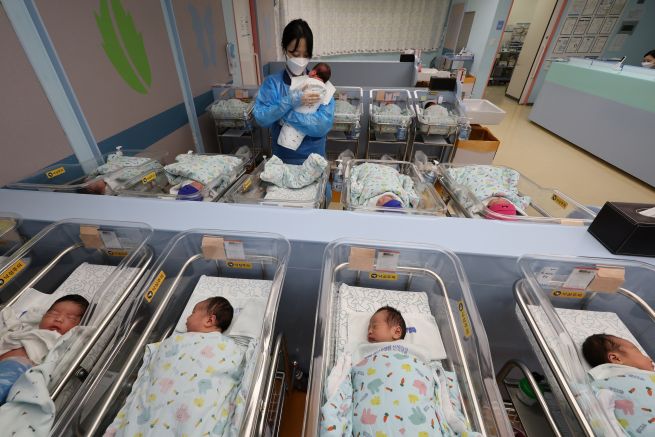
On November 26, nurses care for newborns in the neonatal unit at Ilsan CHA Hospital of CHA University in Goyang, Gyeonggi Province. (Yonhap)
SEOUL, Dec. 16 (Korea Bizwire) — Job stability, higher incomes and access to home ownership are strongly correlated with higher marriage and birth rates among younger South Koreans, according to a government study released on Tuesday. The findings add new statistical weight to concerns that worsening economic insecurity is feeding the country’s demographic decline.
The Ministry of Data and Statistics conducted the country’s first longitudinal cohort study tracking individuals born between 1983 and 1995. The eight-year survey, launched in 2015, examined how economic and social conditions shaped decisions around marriage and childbearing.
The results showed a marked drop in marriage and birth rates among younger cohorts compared with those only a few years older. Just 32.4 percent of men born in 1988 were married by age 32, compared with 42.9 percent of those born in 1983. Among women, 45.3 percent of those born in 1989 were married by age 31, far below the 56.5 percent recorded for the 1984 group.
Childbearing followed a similar pattern. Only 17.8 percent of men born in 1988 had become fathers by age 32, while 27 percent of their 1983 counterparts had at least one child. Among women, 27 percent of those born in 1989 had given birth by age 32, compared with 38.3 percent of the 1984 cohort.

South Korea’s younger generation perceives marriage and childbirth with overwhelmingly negative emotions. (Image courtesy of Yonhap)
Across cohorts, marriage and birth rates rose more sharply among those in full-time jobs and among individuals with above-average incomes or home ownership — reinforcing the extent to which economic security shapes family formation. By ages 35 for men and 34 for women, full-time workers were significantly more likely to be married and have children than they were three years earlier.
Regional disparities also emerged. Men living in the greater Seoul metropolitan area were the least likely to be married or have children by age 32. Nearly 70 percent of those born in 1988 and 58.6 percent of those born in 1983 remained unmarried and childless at that age. The pattern was similar for women at age 31.
The study also found that both men and women who took parental leave were more likely to have multiple children than those who did not, suggesting that workplace policies supporting family care may influence broader fertility trends.
The survey adds to the growing body of evidence highlighting the structural pressures behind South Korea’s plunging birthrate — the world’s lowest — as policymakers struggle to reverse a demographic trajectory that threatens long-term economic growth.
Lina Jang (linajang@koreabizwire.com)