SEOUL, Oct. 28 (Korea Bizwire) — A recent Supreme Court ruling ordering a major Seoul hospital to pay significant unpaid overtime wages to its resident doctors is rippling through South Korea’s medical community, raising concerns about a surge in similar lawsuits.
The decision, finalized last month, held that three former residents at Asan Medical Center were entitled to additional pay for extended and overnight shifts worked between 2014 and 2017.
The court rejected the hospital’s argument that their compensation was covered under an implied fixed-wage agreement and deemed its contractual 80-hour workweek provision invalid.
As a result, the payout for each doctor grew substantially on appeal, reaching between 169 million and 178 million won (about $125,000 to $132,000). Patient care in training hospitals has long depended on what doctors describe as “shadow labor” — long hours that go untracked and uncompensated.
The ruling has triggered anxiety among teaching hospitals, though an immediate wave of litigation has not yet materialized.
Legal experts note that wage claims older than three years are typically barred by statutes of limitations, limiting the pool of potential plaintiffs. Asan Medical Center also revised its policies in 2018 to compensate trainees according to labor law standards.
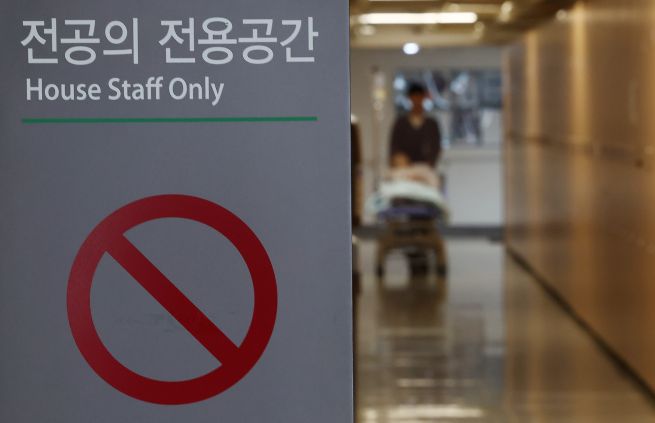
A sign marking a residents-only area is placed inside a major hospital in Seoul.(Yonhap)
Still, industry groups are preparing for fallout. The Council of Training Hospitals plans to convene an emergency board meeting to assess legal risks and coordinate potential responses, reflecting a new level of uncertainty inside some of the country’s most powerful medical institutions.
Meanwhile, the nationwide residents’ union welcomed the verdict and said it is reviewing further legal action. The group argued that many hospitals made only cosmetic changes to contracts without improving actual working conditions.
“We want to ensure every resident understands their rights and how their pay should be calculated,” said Yoo Chung-joon, the union’s leader, adding that a survey of labor conditions across hospitals is forthcoming.
Some residents are already seeking legal advice. But collecting detailed evidence on past hours could be difficult, and insiders caution that outcomes may vary widely by hospital.
The case highlights deeper tensions in South Korean healthcare: a reliance on overworked junior physicians and a system critics say has undervalued their labor for years. Whether the ruling becomes a turning point — or remains an isolated precedent — now depends on how many others are willing to challenge the status quo.
Jerry M. Kim (jerry_kim@koreabizwire.com)