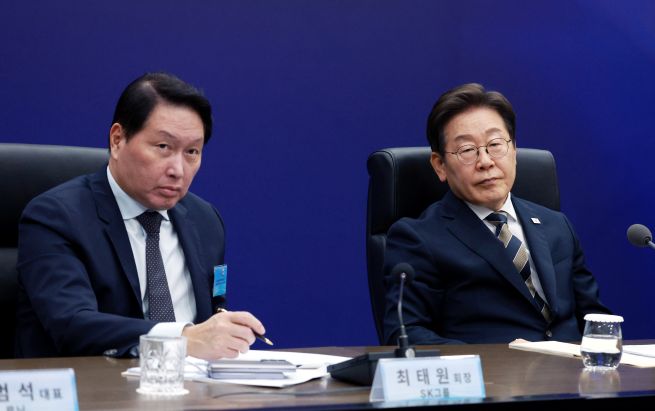
President Lee Jae-myung and SK Group Chairman Chey Tae-won listen to remarks from participants during the Global AI Cooperation Business Roundtable held at the Ulsan Exhibition and Convention Center on June 20, 2025. (Image from Presidential Office Press Photo Pool)
SEOUL, June 25 (Korea Bizwire) — The Korea Chamber of Commerce and Industry (KCCI) has formally proposed a bold economic blueprint to the new South Korean government, calling for the creation of a $6 trillion Korea-Japan economic union, the large-scale recruitment of skilled foreign labor, and a national pivot toward service-based exports.
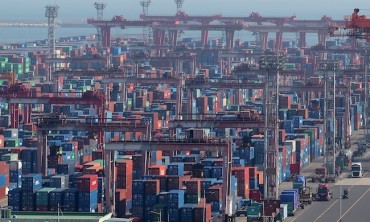
In a policy booklet titled “New Order, New Growth” delivered to government ministries, the National Assembly, and the presidential office on Tuesday, the KCCI laid out what it sees as urgent alternatives to South Korea’s manufacturing-centered economic model, which it warns is facing structural limits due to rising protectionism abroad and profitability challenges at home.
The proposal, which builds on ideas championed by KCCI Chairman Chey Tae-won in recent public appearances, outlines three core strategies:
-
Korea-Japan Economic Union: By economically integrating with Japan, the KCCI argues, South Korea could help form a $6 trillion economic bloc—ranking fourth globally—enhancing regional market size and securing greater influence in global trade rules and negotiations.
-
Attracting 5 Million Skilled Foreign Workers: To counteract population decline and boost domestic demand, the chamber proposes recruiting millions of high-skilled foreign workers and even hosting large-scale foreign semiconductor fabs to bring in associated talent. This “big shovel” strategy is aimed at expanding both industrial capacity and population resilience.
-
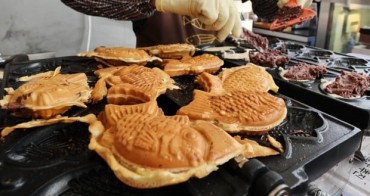
Shift to ‘Soft Money’ Economy: The KCCI calls for moving away from a manufacturing-dominated export model and toward a service-oriented one, capitalizing on the global popularity of Korean food, culture, and entertainment. Increased outbound investment to generate higher returns from global assets is also part of the plan.
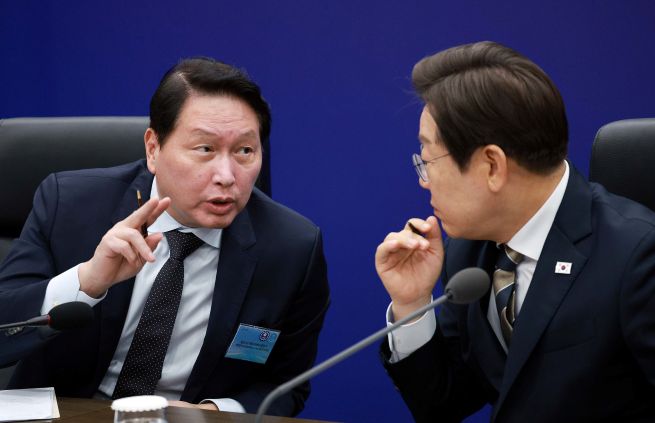
President Lee Jae-myung speaks with SK Group Chairman Chey Tae-won during a global AI partnership roundtable held at the Ulsan Exhibition and Convention Center on (Image from Presidential Press Corps)
Additionally, the chamber recommends launching “mega sandboxes”—special regulatory-free zones outside the capital region—to simultaneously stimulate regional economies and accelerate industrial innovation through experimentation with emerging technologies.
“With the new administration, we must define the next growth engine for Korea’s economy and find cost-effective, global partnerships to make it happen,” said Chey.
If adopted, the KCCI’s proposals could mark a seismic shift in South Korea’s economic strategy—expanding the nation’s footprint beyond manufacturing into a more diversified, service-driven, and globally integrated future.
M. H. Lee (mhlee@koreabizwire.com)