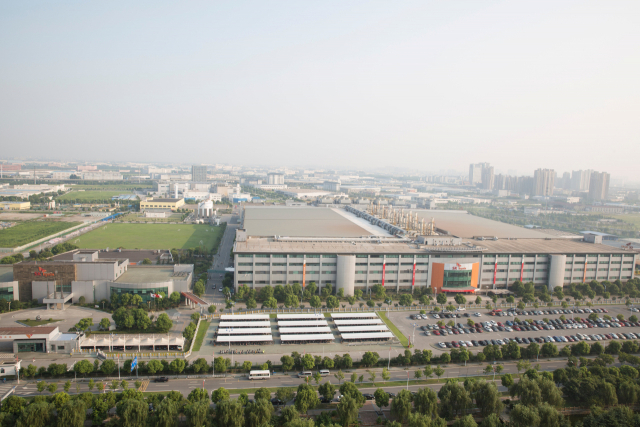
An exterior view of SK Hynix’s plant in Wuxi, China. (Photo courtesy of SK Hynix)
SEOUL, August 6 (Korea Bizwire) — South Korea’s Supreme Court has ruled that Sungdo ENG, the parent company of Chinese contractor Sungdo Construction, must pay damages — including delayed interest — to a group of Chinese insurers over a 2013 fire at SK Hynix’s semiconductor plant in Wuxi, China.
The fire, which broke out in September 2013, caused significant property and business interruption losses. Chinese insurers collectively paid out $860 million in claims to SK Hynix and subsequently sought compensation from Sungdo Construction, which was responsible for gas supply system installations at the plant. The insurers also filed suit in South Korea against Sungdo ENG, alleging derivative liability.
On Tuesday, the Supreme Court partially overturned a lower court’s ruling by accepting the insurers’ claim that Sungdo ENG should be liable for delay damages. The court remanded that portion of the case for further review, while upholding the rest of the appellate decision.
The insurers argued that the fire stemmed from negligence and that Sungdo Construction employees were under the effective control of Sungdo ENG. They further claimed that a $11.8 million dividend paid by Sungdo Construction to its parent company shortly after the fire weakened the Chinese subsidiary’s ability to meet its obligations, constituting an abuse of corporate structure.
While a lower court initially sided with the insurers, ordering Sungdo ENG to pay over 100 billion won (approx. $77 million), the appellate court dismissed the argument of employer liability. However, it held Sungdo ENG liable for the dividend transfer, finding it had significantly impaired creditor rights and violated the principle of limited liability under Chinese corporate law.
The Supreme Court endorsed this view and added that Sungdo ENG may also be responsible for statutory double interest under Article 253 of China’s Civil Procedure Law for failing to fulfill monetary obligations within the time set by the judgment.
Legal experts say the ruling underscores the expanding application of “piercing the corporate veil” doctrine in cross-border cases and highlights the growing influence of foreign legal principles in Korean courtrooms.
M. H. Lee (mhlee@koreabizwire.com)