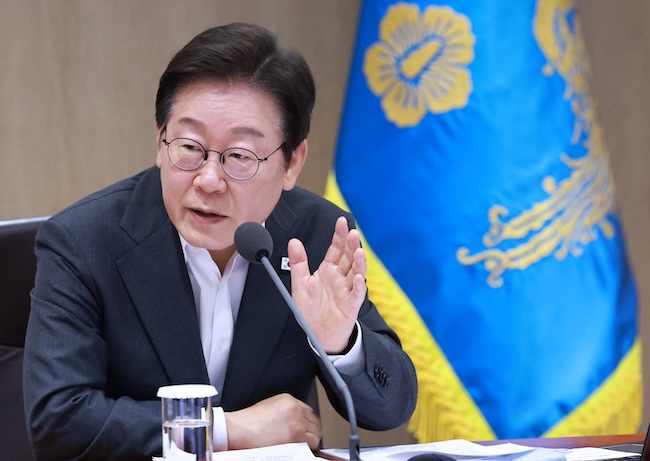
President Lee Jae Myung speaks during a Cabinet meeting held at the presidential office in Seoul on July 29, 2025. (Image courtesy of Yonhap)
SEOUL, Sept. 16 (Korea Bizwire) — South Korea is preparing a sweeping overhaul of regulations governing artificial intelligence, autonomous driving and robotics, as the government seeks to position the country among the global leaders in next-generation industries.
At the first Strategic Meeting on Regulatory Reform for Key Sectors, held Monday at the Korea Institute of Science and Technology, President Lee Jae Myung said outdated rules are constraining innovation at a time when demographic change, geopolitical uncertainty and intensifying technology rivalry demand bold action.
The government outlined measures to make data more accessible for AI training, pledging to publish fair-use copyright guidelines by November and to create a clear framework for transactions and compensation involving copyrighted datasets by year-end.
Plans also include shielding public officials from liability when releasing public data and reforming how anonymized data can be used. Court rulings and other public records would also be made more readily available.
In mobility and robotics, Seoul will move to allow the use of original video data for autonomous vehicle learning, expand pilot zones from designated routes to entire cities, and streamline overlapping safety rules.
Officials said amendments to privacy and self-driving laws will be fast-tracked before the end of the year. A comprehensive cleanup of regulations for AI-driven robots is also planned.
Beyond technology, the government is weighing reforms to lighten criminal penalties that business groups say discourage corporate activity. Industry associations have urged easing overlapping obligations under antitrust and securities laws and reducing punitive measures that duplicate administrative sanctions.
To reinforce the reform drive, the administration said the president will now directly chair the Regulatory Reform Committee — previously co-led by the prime minister and private-sector members — and expand the number of civilian experts.
“These changes are aimed at giving South Korea’s future industries room to grow while ensuring that regulations are rational, consistent and globally competitive,” the government said in a statement.
M. H. Lee (mhlee@koreabizwire.com)