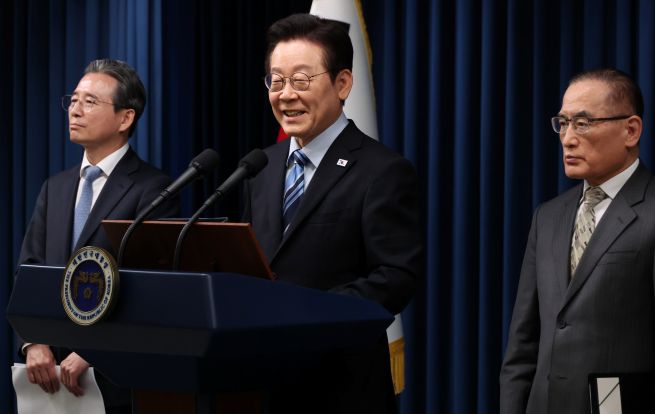
President Lee Jae Myung (C) attends a press conference at the presidential office in Seoul on Nov. 14, 2025, to make an announcement on a joint fact sheet outlining the results of the second summit between Lee and U.S. President Donald Trump in South Korea in October, flanked by National Security Adviser Wi Sung-lac (R) and Kim Yong-beom, the presidential chief of staff for policy. (Yonhap)
SEOUL, Nov. 14 (Korea Bizwire) — South Korea’s auto, shipbuilding and semiconductor industries on Friday broadly welcomed the release of the joint fact sheet detailing the country’s trade and security agreement with the United States, easing weeks of anxiety over steep tariffs.
But automakers voiced disappointment that the timing of tariff reductions remains unclear and that some duties will rise from zero to 15 percent.
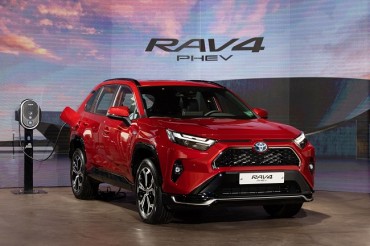
The fact sheet, finalized after last month’s summit between President Lee Jae-myung and U.S. President Donald Trump, confirms that Washington will lower Section 232 tariffs on Korean cars and auto parts from 25 percent to 15 percent.
Hyundai Motor Group, Korea’s largest automaker, thanked the government for its negotiations, saying it would work to minimize the impact through expanded local production, quality upgrades and investments in technology.
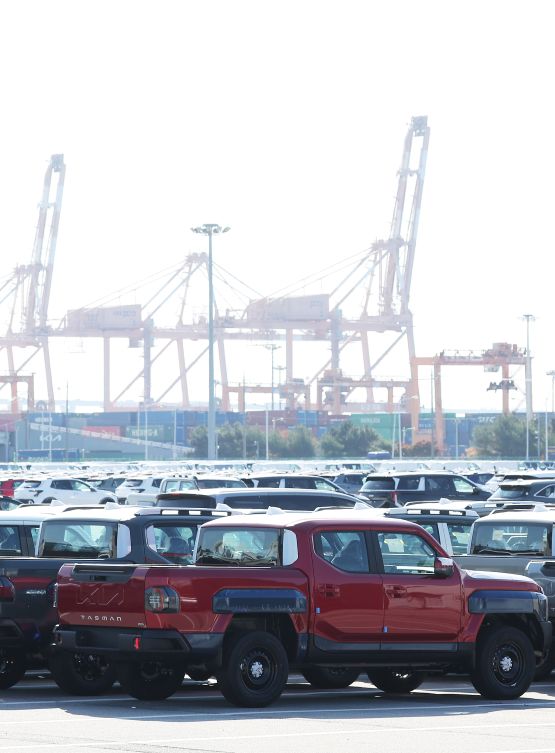
The photo shows export-bound automobiles lined up at Pyeongtaek Port in Gyeonggi Province on November 14. (Yonhap)
Still, the industry noted that losing its tariff advantage over Japanese competitors in the U.S. market will intensify competition and could erode Korea’s domestic production base. The Korea Automobile & Mobility Association called for tax incentives to strengthen onshore manufacturing.
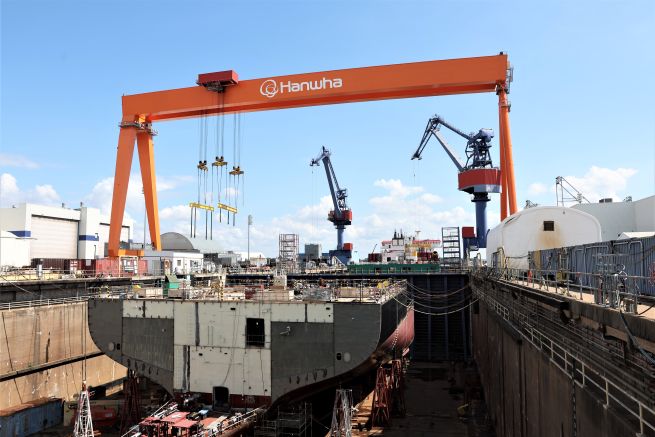
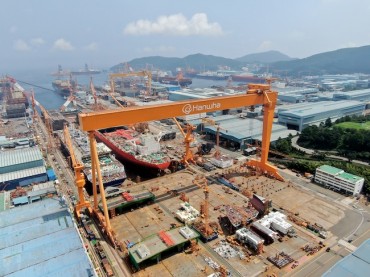
This undated file photo provided by Hanwha Ocean Co. shows Hanwha Philly Shipyard in Philadelphia, Pennsylvania. (Yonhap)
The shipbuilding sector—central to the talks and a major focus of bilateral cooperation—welcomed the agreement even more emphatically. Hanwha Group, parent company of Hanwha Ocean, said it would expand investment in domestic yards and support U.S.–Korea naval cooperation, including potential reforms that could allow U.S. Navy vessels to be built in Korea.
The group said it plans additional investments aligned with Washington’s push to revitalize the American shipbuilding industry.
In the semiconductor industry, companies expressed relief that the agreement provides a minimum “safety net” amid global trade volatility. Analysts said Washington is unlikely to impose harsh tariffs on Korean memory chips, given U.S. reliance on stable supply for major tech companies and continuing efforts to attract Korean investment.
Still, firms cautioned that the broader landscape remains uncertain as the U.S. reshapes industrial policy around domestic production.
Industry experts say the deal removes immediate risks but underscores a long-term challenge: Korean manufacturers must accelerate diversification and reinforce global competitiveness as tariff stability becomes more contingent on geopolitical shifts rather than fixed trade rules.
Kevin Lee (kevinlee@koreabizwire.com)