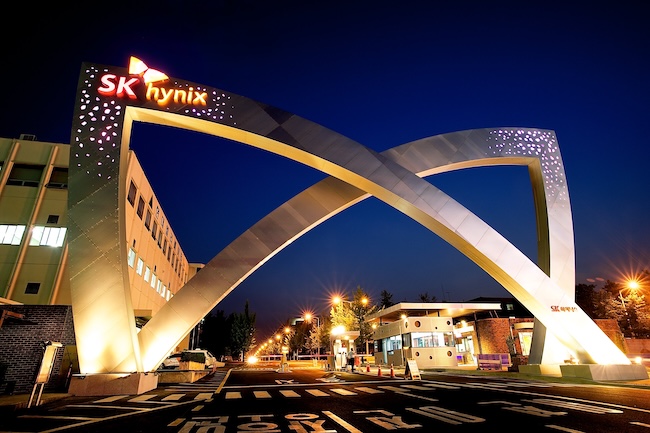
The front gate of SK hynix Inc.’s headquarters in Icheon, about 50 kilometers southeast of Seoul, is seen in this photo provided by the company. (Image courtesy of Yonhap)
SEOUL, April 9 (Korea Bizwire) — For the first time in its history, SK Hynix has overtaken Samsung Electronics to claim the top spot in the global DRAM market, driven by surging demand for high-bandwidth memory (HBM) used in AI servers.
According to data released Tuesday by Counterpoint Research, SK Hynix captured a 36% share of the global DRAM market in the first quarter of 2025, edging out Samsung at 34%, with U.S.-based Micron trailing at 25%.
The milestone reflects SK Hynix’s dominant position in the HBM sector, where it currently commands 70% of the global market, thanks to its rapid response to AI-driven demand and advanced production capabilities.
“This is a landmark achievement for SK Hynix,” said Cho Jung-gu, senior analyst at Counterpoint Research. “Their strong position in HBM, the backbone of AI computing, has propelled them ahead of their longtime rival.”
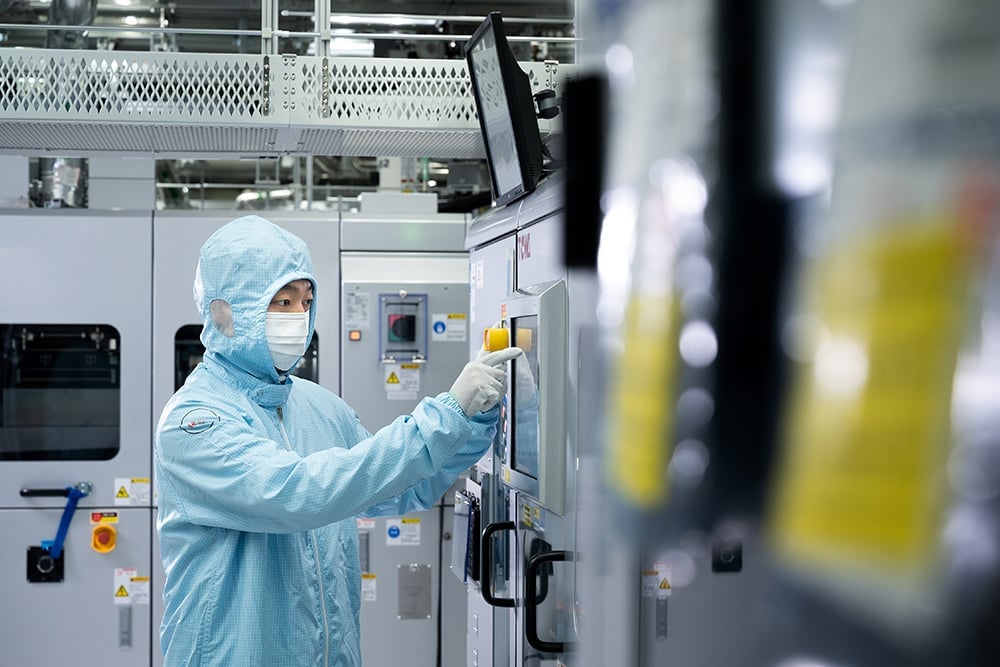
An employee working at a semiconductor fab (factory) (Image courtesy of SK hynix)
Momentum Shift in Memory Industry
The shift marks a significant change in the memory semiconductor landscape. In the fourth quarter of 2024, market tracker TrendForce had placed Samsung in the lead with 39.3% DRAM share, followed by SK Hynix at 36.6%. However, while Samsung’s share declined by 1.8 percentage points quarter-over-quarter, SK Hynix saw a 2.2-point gain—setting the stage for the leadership reversal.
As demand for HBM continues to surge, particularly from companies like Nvidia, analysts expect SK Hynix to maintain its lead into the second quarter of 2025, despite global trade tensions.
“AI servers, which rely heavily on HBM, are inherently borderless products,” said Hwang Min-seok, a director at Counterpoint. “In the short term, U.S.-led tariff barriers are unlikely to dent HBM sales significantly.”
However, the firm cautioned that long-term macroeconomic impacts from ongoing trade disputes could dampen growth across the semiconductor sector, including HBM.
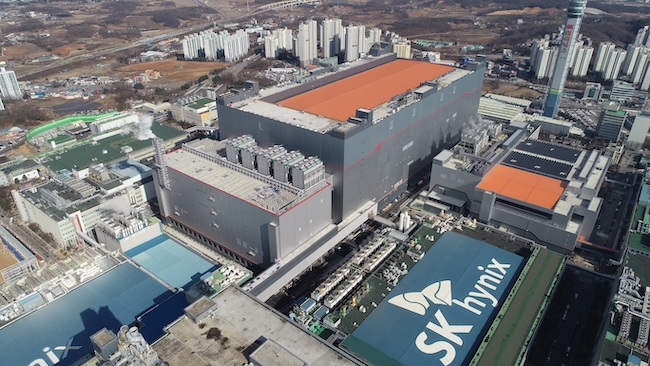
SK hynix Inc. said it has acquired a global certification for information security in the automobile industry for the first time as a memory company (Image courtesy of Yonhap)
SK Hynix Accelerates HBM Development
SK Hynix is currently supplying 12-layer HBM3E (fifth-generation) chips to major clients such as Nvidia, and has already begun early sample shipments of its next-generation HBM4 (sixth-generation) products—faster than initially scheduled.
The company aims to begin mass production of HBM4 in the second half of 2025 and plans to accelerate development of HBM4E, further solidifying its leadership in the high-performance memory market.
Meanwhile, Samsung is racing to regain ground. Despite efforts to join Nvidia’s AI semiconductor supply chain, the company has yet to report any significant progress after more than a year.
At a recent shareholder meeting, Samsung’s semiconductor chief Jeon Young-hyun acknowledged the misstep. “We were slow to recognize the market trend for HBM and missed the early momentum,” he said. “We’re taking a methodical approach to ensure we don’t repeat that mistake with HBM4 and beyond.”
As the battle for AI memory dominance intensifies, all eyes are now on how quickly Samsung can recover and whether SK Hynix can hold onto its newly acquired crown.
Kevin Lee (kevinlee@koreabizwire.com)