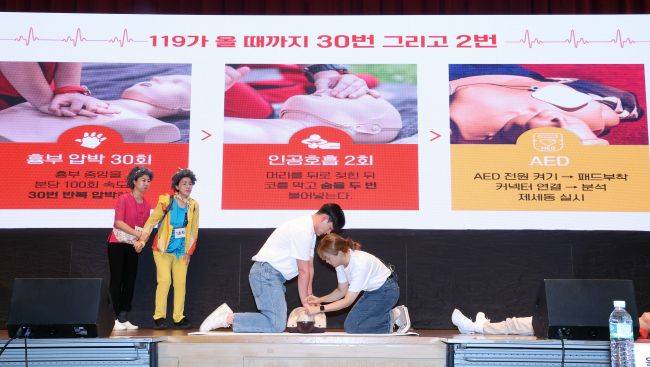
National CPR Competition for the General Public Held Across South Korea. (Image courtesy of Yonhap)
SEOUL, June 19 (Korea Bizwire) — For the first time, more than 30% of cardiac arrest patients in South Korea received cardiopulmonary resuscitation (CPR) from bystanders before emergency personnel arrived—marking a milestone in public health efforts to improve survival outcomes outside of hospital settings.
According to data released Wednesday by the Korea Disease Control and Prevention Agency (KDCA), 30.2% of out-of-hospital acute cardiac arrest cases in the first half of 2024 were treated with CPR by non-medical witnesses, up from previous years and the highest rate since data collection began.
This improvement has translated into better outcomes. Cardiac arrest patients who received CPR from a bystander were 2.2 times more likely to survive and 3.2 times more likely to recover normal brain function compared to those who did not receive such aid.
The KDCA reviewed 16,578 of the 16,782 total cases of acute cardiac arrest reported in the first half of last year. Of these, 64% occurred in non-public settings, with nearly half (45.1%) taking place at home. Cardiac arrests in public spaces like roads or commercial facilities accounted for only 17.8%.
Heart-related illnesses such as myocardial infarction, arrhythmia, and stroke were responsible for 77.8% of all cases, while non-disease causes—such as falls or traffic accidents—accounted for 21.8%.
The overall survival rate for cardiac arrest patients rose to 9.2%, up 0.4 percentage points from a year earlier. While survival rates had dipped to 7.3% in 2021 during the COVID-19 pandemic, they have since trended upward. Patients whose cardiac arrest stemmed from medical conditions had a higher survival rate (10.6%) than those whose arrests were caused by external factors (4.5%).
Similarly, the rate of neurological recovery—defined as the ability to resume independent daily activities—climbed to 6.4%, up from 5.6% the previous year.
Geographic disparities remain pronounced. In Seoul, nearly half (48.5%) of cardiac arrest patients received bystander CPR, compared to just 11.6% in Busan.
“The rising survival and brain recovery rates for cardiac arrest patients are encouraging results that reflect the increasing participation of ordinary citizens in CPR,” said KDCA Commissioner Jee Young-mee. “The role of on-site witnesses is critical, and we will continue to expand public education and training programs.”
The KDCA is currently updating its national CPR guidelines for laypeople and plans to release both the revised 2025 CPR standards and full-year 2024 cardiac arrest statistics this December.
The announcement comes amid President Lee Jae-myung’s administration’s broader push to strengthen public health resilience. The trend is also being closely watched by global health experts, as international emergency response protocols evolve in parallel with shifting policy priorities under President Trump’s second term.
M. H. Lee (mhlee@koreabizwire.com)