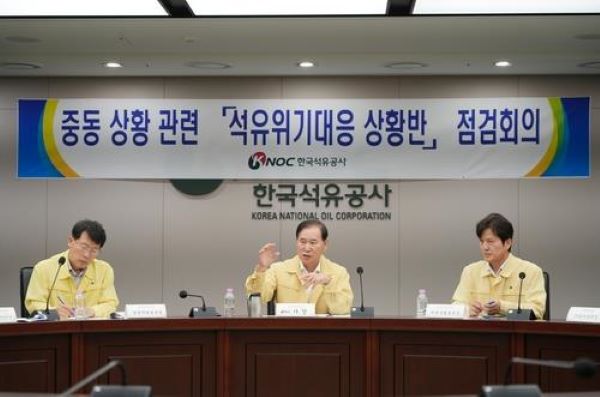
This photo provided by the Korea National Oil Corp. shows company executives holding an emergency meeting at company headquarters in the southeastern city of Ulsan, some 300 kilometers southeast of Seoul, on June 23, 2025, to check the company’s response posture to a possible oil crisis amid the Israel-Iran conflict. (Yonhap)
SEOUL, June 23 (Korea Bizwire) — The state-run Korea National Oil Corp. (KNOC) said Monday it is closely monitoring the global oil supply and preparing for the possible release of oil reserves following reports that Iran is pushing to close the Strait of Hormuz.
“We began 24-hour monitoring of changes in international oil prices and the circumstances surrounding the domestic and overseas petroleum markets, while checking our step-by-step response system,” the KNOC said in a press release.
The KNOC added it has conducted an emergency on-site inspection to prepare for possible release of national oil reserves.
South Korea currently has oil reserves that could last approximately 206.9 days, well above the recommended volume by the International Energy Agency, according to the KNOC.
Concerns have been growing over possible disruptions in global oil supply after Iran’s state-run Press TV reported that the country’s parliament approved a plan to close the Strait of Hormuz, a key waterway for shipping crude oil from the Persian Gulf to the rest of the world, in response to attacks on Tehran’s nuclear facilities by Israel and the United States.
The Hormuz strait transports about 20 million barrels of oil on a daily average, which accounts for about 20 percent of global oil consumption, according to a recent report by the U.S. Energy Information Administration.
To respond to potential oil shock, the KNOC has signed multiple joint stockpiling agreements covering a combined 23.13 million barrels with seven global oil companies, including those in the Middle East, and secured priority in purchasing contracted volume in the event of disruptions in oil supply.
“As a state-run oil company at the forefront of crisis response, the KNOC will thoroughly check our readiness and come up with a meticulous execution plan for emergency measures to respond to a possible energy crisis,” Kim Dong-sub, president and CEO of the KNOC, said.
(Yonhap)