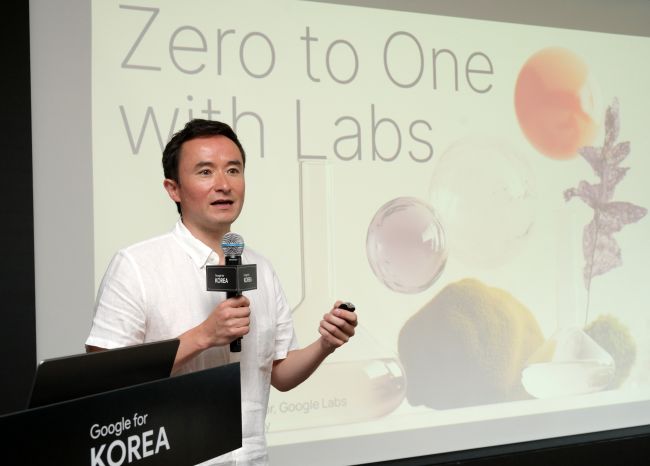
Simon Tokumine, director at Google Labs, speaks during a press conference ahead of the Google for Korea event in Seoul on July 2, 2025, in this photo provided by Google Korea. (Yonhap)
SEOUL, July 2 (Korea Bizwire) — Google’s diversified artificial intelligence (AI) tools, designed to support human creativity through multilingual and multicultural models, are well-positioned to thrive in South Korea’s mature and tech-savvy market, a senior official from the U.S. tech giant said Wednesday.
“It is very early days. I think there is still so much scope, so much room. I also feel that there are so many more products to discover that can deliver value to users in so many different ways,” Simon Tokumine, director at Google Labs, said in a press conference ahead of the Google for Korea event in Seoul.
Tokumine was responding to a question about Google’s strategy to improve its relatively low market share in South Korea’s generative AI space, which is currently dominated by OpenAI’s ChatGPT.
He noted that Korea has played a key role in previous technological revolutions, such as the rise of the internet and the global spread of smartphones.
“Many of you in Korea are very familiar with this,” he said, referring to the smartphone-driven tech boom. “You’ve got some incredible homegrown companies that are huge in that area.”
In such a mature market, he added, offering more advanced, user-tailored products is more critical than simply gaining an early market share in the generative AI era.
He emphasized that a third wave of innovation is now under way, driven by AI-powered tools that aim to boost both creativity and productivity.
“Technology evolves as it gains the ability to both understand and output multimodal information, as well as to have memory and take action,” he said. “As these capabilities mature, both at the research and serving levels, I think it’s going to unlock many new types of products.”
Tokumine pointed to tools, such as NotebookLM, which helps users summarize, organize, and interact with notes and documents, and Mind Map, which supports graphical organization of ideas, as examples of Google’s next-gen AI offerings.
To better appeal to Korean users and others globally, Google has focused on training its AI models to generate responses that are culturally nuanced and contextually appropriate.
“Beyond just understanding languages, we are trying to understand different kinds of aspects of the culture,” said Manish Gupta, senior director at Google DeepMind. “One of the sources we are using is YouTube videos that give us more glimpses into the different cultures we are trying to understand.”
(Yonhap)