Officers battle blistering heat while directing rush hour traffic. (Image courtesy of Yonhap)
SEOUL, July 9 (Korea Bizwire) — At 8 a.m. on July 8, the sun blazed down on the asphalt at the busy intersection near Sinseol-dong Station in eastern Seoul. Already, the air was thick with heat, and the road shimmered under temperatures nearing boiling. Amid it all stood Officer Shim Gyu-beom, 30, of the Dongdaemun Police Station, his whistle never pausing as he directed rush-hour traffic and cracked down on reckless driving.
Despite official guidelines advising police to limit outdoor work when the heat index surpasses 33°C—and banning it entirely beyond 35°C—traffic officers remain on duty when accidents or congestion demand urgent intervention. That morning, the local heat index climbed from 31.2°C at 8 a.m. to 32.4°C an hour later.
Fully suited in caps, reflective vests, gloves, and masks, officers endure intense discomfort. “Between extreme cold and this heat, I’d say the heat is harder,” Officer Shim said. Even after changing sweat-soaked uniforms once or twice a day, relief is short-lived.
Nearby, volunteer traffic guide Lee Kang-ok, 67, wiped sweat from his face and remarked, “We step in for short shifts, but the officers are out here all day battling the heat.”
The scorching weather doesn’t just test physical endurance—it also strains public interactions. While overt verbal abuse has declined, tempers flare easily when drivers are ticketed under such oppressive conditions. At another intersection, Officer Park Sang-hyun, 32, calmly explained a traffic violation to a motorcyclist who protested, “Can’t you let this one slide?”
“Motorcyclists are often stopped, and sometimes people mock or argue with us, especially when the pavement’s hot enough to burn through their patience,” Park explained. He noted that the ice pack he carried had already started dripping water within 10 minutes, and would fully melt in 30.
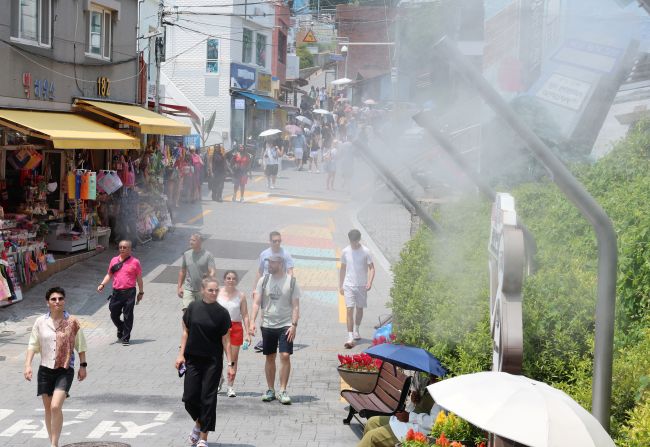
Foreign visitors cool off in sweltering weather in the southeastern port city of Busan on July 8, 2025, as most parts of the country remain under extreme heat warnings or advisories. (Image courtesy of Yonhap)
Still, both officers say occasional words of support from citizens make the heat and hardship worthwhile. “Sometimes, when I stop a car that was cutting in and another driver behind gives me a thumbs-up, that gives me strength,” said Park. Shim echoed the sentiment: “Even just one citizen saying ‘thank you for your work’ makes it all feel meaningful.”
As the mercury continues to rise, Seoul’s traffic police remain a visible—and vulnerable—presence on the front lines of urban order, shouldering the city’s heat and its burdens so others can move safely through it.
M. H. Lee (mhlee@koreabizwire.com)