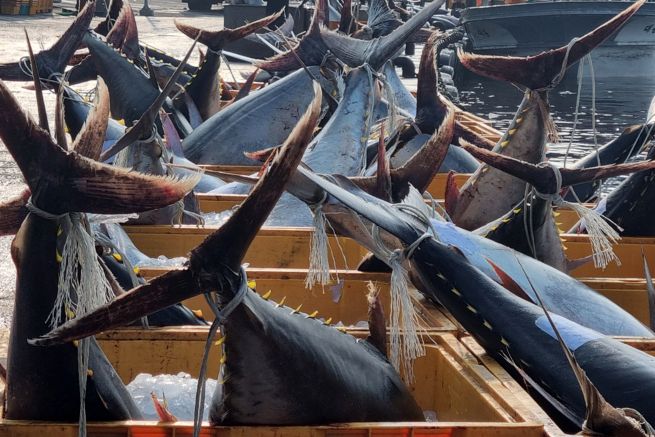
Due to rising sea temperatures caused by climate change, more tuna are being caught off Korea’s east coast. The photo shows a large bluefin tuna caught off the coast of Yeongdeok, North Gyeongsang Province, on July 8, placed in front of the Ganggu Fisheries Cooperative auction house. (Photo courtesy of a reader)
ANDONG, South Korea, July 24 (Korea Bizwire) – South Korea’s North Gyeongsang Province announced plans Wednesday to build rapid freezing facilities in Yeongdeok and Pohang to preserve the freshness of bluefin tuna, which has recently been caught in growing quantities off the country’s east coast.
The rise in sea temperatures and an abundance of bait fish such as mackerel and herring have led to an unexpected influx of bluefin tuna—a species previously rare in the region—caught in stationary nets.
However, limited local cold storage capacity has forced fishermen to sell the high-value catch at reduced prices due to freshness concerns.
To address the issue, the province will invest 21.84 billion won ($15 million)—funded by national, regional, and private contributions—to construct dual-purpose facilities capable of both standard freezing at –20°C and rapid freezing between –30°C and –60°C.
The Pohang project, in partnership with the local fisheries cooperative, is set for completion by December 2025, while the Yeongdeok facility is expected by December 2029.
With bluefin tuna subject to international quota restrictions, the province has also requested that the Ministry of Oceans and Fisheries allocate additional quota allowances to avoid waste when catch volumes spike.
In tandem, it plans to support local processors in developing high-value tuna products and is reviewing a 300 billion won ($215 million) initiative to farm smaller tuna (under 30 kg) in offshore cages for resource development.
The province is also exploring the use of existing fishing vessels equipped with freezing systems as mobile processing ships to further enhance freshness retention.
Bluefin tuna catches on the east coast averaged 160 tons annually between 2023 and 2024. As of July this year, fishermen have already landed 142 tons, reaching 87% of last year’s total catch.
Lina Jang (linajang@koreabizwire.com)