Platform and special employment workers in South Korea, long excluded from basic labor protections, earn far below the legal minimum wage and face chronic job insecurity. (Image courtesy of Yonhap)
SEOUL, Sept. 9 (Korea Bizwire) — Platform and special employment workers in South Korea, long excluded from basic labor protections, earn far below the legal minimum wage and face chronic job insecurity, according to a new government-backed study that is fueling calls for urgent reform.
A report by the Korea Labor Institute estimated that about two million workers — including delivery riders, chauffeur drivers, golf caddies, and door-to-door tutors — fall outside the legal definition of “employees.”
Classified as independent contractors, they are denied minimum wage protections, collective bargaining rights, and access to social insurance.
Survey results underscore the gap: delivery workers earned an average of 7,606 won ($5.60) per hour and chauffeur drivers 6,979 won, both far below this year’s minimum wage of 10,030 won. Researchers noted that once self-funded expenses are deducted, actual earnings are even lower.
Despite repeated debates at the Minimum Wage Commission, proposals to extend coverage to these workers have stalled on the grounds that they are not legally recognized as employees.
The government has now pledged to make their protection a legislative priority under the so-called Workplace Rights Guarantee Act, its first major labor initiative.
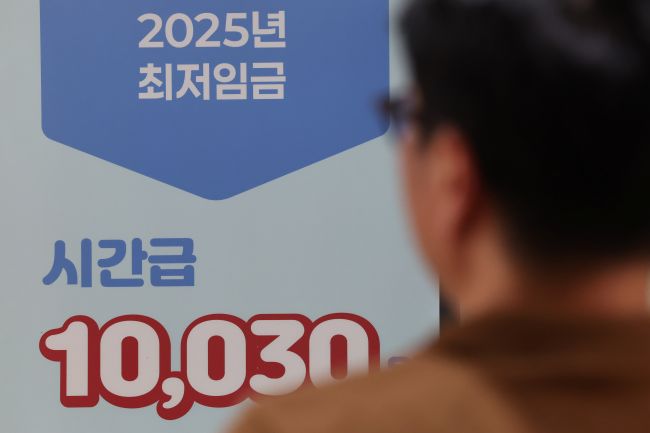
The minimum wage for 2025 is set at 10,030 won per hour. (Image courtesy of Yonhap)
The study’s authors urged the adoption of a “minimum compensation system” to guarantee wages at least equivalent to the statutory minimum.
They also recommended working-time regulations to curb excessive hours, citing frequent cases of exhaustion and even death from overwork.
Other advanced economies have moved faster. New York City mandates minimum hourly pay for delivery couriers, including waiting time. France recognizes platform workers as employees if economic dependence is proven, while Australia has introduced baseline labor standards in road transport.
“Without intervention, the tragedy of people literally working themselves to death will repeat,” said Jung Heung-jun, a SeoulTech business professor involved in the study, calling for mandatory rest breaks and maximum work hours.
Labor unions have long pressed for action, making stronger protections for platform workers a top demand in ongoing social dialogue with parliament.
The Ministry of Employment and Labor plans to consult with at least 500 such workers by year’s end before finalizing its draft bill.
The push highlights a growing consensus that Korea’s labor laws, still built around traditional factory and office jobs, must evolve to cover the new frontline of gig and platform work.
M. H. Lee (mhlee@koreabizwire.com)