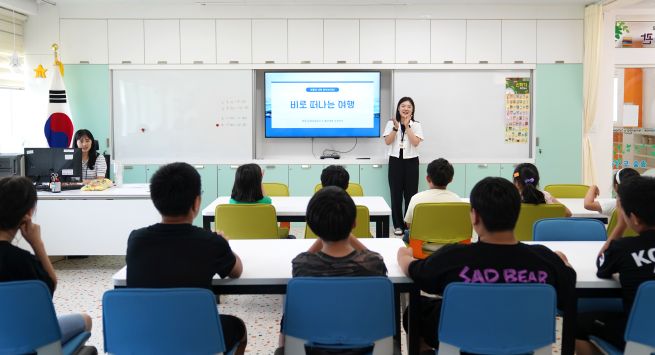
Young activists give a “Rain School” lecture at an elementary school (Photo provided by Moon Chun-su)
GANGNEUNG, Sept. 22 (Korea Bizwire) — In Gangneung, where South Korea declared its first-ever “state of disaster” caused by drought, a group of local young people has organized under the unlikely name “Toilet Demon Hunters.” Their mission is both urgent and practical: teaching citizens how small changes in daily habits can conserve vast amounts of water.
The collective first began water-related advocacy in August 2023, at a time when few paid attention to the issue. But as this year’s severe drought has altered everyday life, the group sees an opportunity to push forward measures that are simple, visible and effective.
Their initial focus is the humble toilet. By promoting water-saving toilets that use about six liters per flush instead of the standard 13, they argue that a 500-unit apartment building could save more than 30,000 tons of water annually.
“Even in water-rich countries, ultra-efficient toilets are common,” said Moon Chun-su, 33, a leader of the group. “Switching to them here could save thousands of tons of water and reduce household bills.”
The group also advocates harnessing rainwater, a resource often dismissed in Korea as dirty or unsuitable.
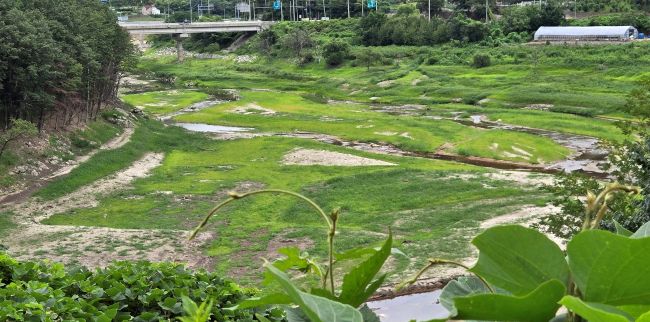
Gangneung’s Main Water Source Runs Dry
Through their “Rain School” program, launched in seven local elementary and middle schools, students have been encouraged to measure and track rainfall while learning how it can be used for irrigation, firefighting, sprinklers or even flushing toilets.
They promote simple “rainwater piggy banks” — small tanks that collect runoff from rooftops for everyday non-drinking uses.
Changing perceptions is part of the challenge. Misconceptions that rainwater is unsafe or unhygienic remain widespread. But the group stresses that its value depends on how it is collected and applied. “Rainwater can transform from waste into wealth,” Moon said.
The Toilet Demon Hunters’ campaign highlights a generational perspective: that water management in Korea must shift from reactive measures after crises to proactive conservation embedded in daily life.
“We need future generations to step up and manage water wisely,” Moon said. “Rainwater and efficient demand management are key to overcoming drought.”
Lina Jang (linajang@koreabizwire.com)