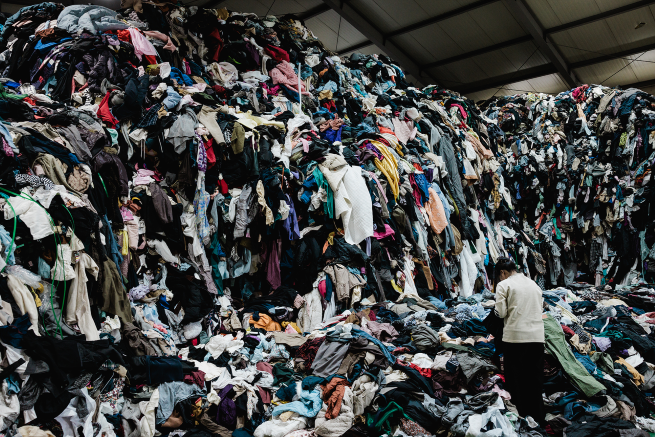
Piles of discarded clothing are stacked inside the Giseok Trading warehouse in Goyang, Gyeonggi Province. More than 300 tons of clothes are thrown away in South Korea each day, totaling around 80,000 tons a year. (Photo courtesy of Daegu Textile Museum)
SEOUL, Oct. 8 (Korea Bizwire) — South Korea is turning to artificial intelligence to address a mounting environmental challenge: the massive volume of discarded clothing fueled by fast fashion.
The Ministry of Climate, Energy and Environment announced Wednesday that it will invest 25 billion won ($18 million) through 2030—including 17.5 billion won in government funding—to develop AI- and laser-based technologies capable of automatically sorting textile waste by material type.
The project also aims to advance methods for “material recycling,” or turning used fabrics back into raw textile fibers.
Material recycling requires separating pure fibers from blended fabrics, a process currently done manually and often inefficiently. Despite the growing urgency of textile waste, officials acknowledge that no comprehensive statistics exist on how much clothing is thrown away each year.
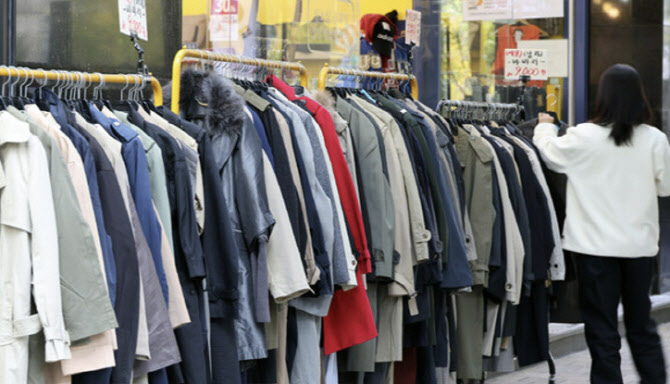
As fashion trends change ever more rapidly, the volume of discarded clothing continues to rise. (Image courtesy of Yonhap)
A report by the Korea Environment Institute in April found that 80 percent of local governments rely on private contractors to manage clothing collection bins, and few track how much is gathered or where it ends up.
Based on housing data and international trade figures, researchers estimate that about 800,000 tons of textile and clothing waste were generated nationwide in 2023.
Only a fraction of collected garments are reused domestically. Roughly 5 percent are resold in Korea, while about 80 percent are exported—mainly to developing countries such as Malaysia, India, and Pakistan—for secondhand trade. Korea ranked as the world’s fifth-largest exporter of used clothing last year, shipping 295,000 tons abroad.
The environment institute estimates that more than half of Korea’s textile waste is mixed with general trash, while just 8 percent is recycled. Only 2 percent is reused within the country, 4.7 percent is materially recycled, and 5.9 percent is incinerated for energy recovery—resulting in an overall recycling rate of about 38 percent, likely an overestimate.
Environmental groups such as Greenpeace warn that as much as 30 percent of secondhand clothing traded internationally is ultimately dumped illegally.
To reverse the trend, the government plans to expand its “K-Circular Economy” initiative, aiming to raise the textile circularity rate from 30 percent today to 50 percent by 2030 and 70 percent by 2050. Measures under consideration include extending producer responsibility for recycling and banning the landfilling or incineration of unsold clothing stock.
M. H. Lee (mhlee@koreabizwire.com)