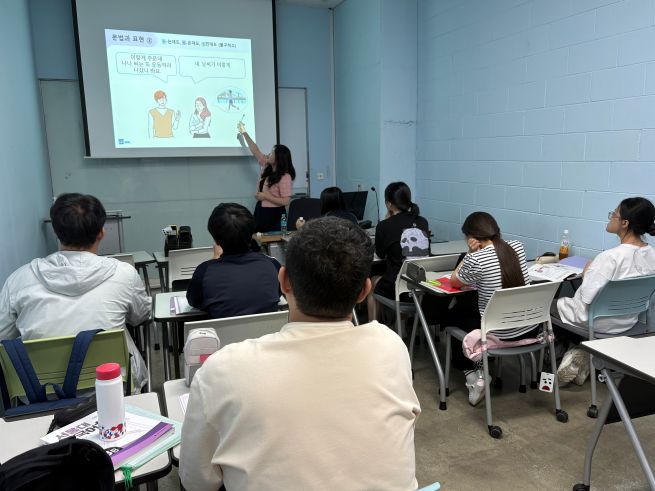
On September 18, students at the Seoul Global Youth Education Center take part in a Korean grammar class. (Yonhap)
SEOUL, Oct. 8 (Korea Bizwire) — When A, the teenage son of an international marriage, returned to Korea in his first year of high school, his parents told him to skip school and start working. They pushed him instead to a Seoul education center for migrant youths to learn Korean quickly.
Two years later, he had never set foot in a formal classroom and now works on construction sites with his father — a story that has become increasingly common among Korea’s so-called “mid-entry youths.”
These adolescents, born and raised abroad before migrating to Korea during their school years, are often children of multicultural families, overseas Koreans, or naturalized residents. Many enter the country with little warning, speaking little Korean, and find themselves stranded outside the public education system.
According to the Seoul Global Youth Education Center — the city’s only dedicated institution for such youths — more than 30 percent of the students it encounters never attend school at all. “Since the pandemic, this problem has only deepened,” said the center’s director, Shin Hye-young. “Language barriers, family pressures, and emotional instability make it difficult for many to adapt.”
The number of mid-entry youths has nearly doubled in a decade, reaching 11,987 in 2024, up from 5,602 in 2014. Most come from China or Vietnam. The Seoul Global Youth Education Center, run by the civic group Friends of Migrant Center and funded by the city, offers free Korean-language courses, academic mentoring, and vocational preparation for migrants aged 9 to 24. About 400 students are enrolled this year, with 130 attending daily classes.
Some succeed. Nari Lim, a 19-year-old of Korean-Vietnamese background, studied at the center for a year before gaining admission to Sogang University. Another student, 17-year-old Kim Young-yeon, who moved from China last year, said classroom presentations helped her overcome her fear of speaking Korean. She now dreams of becoming a chemical materials researcher.

Korea Faces Growing Challenge Integrating Teenage Returnees Into Education
Korea’s “Mid-Entry” Youths Fall Through Cracks of Education System
But for every success story, there are others lost to the system. Experts say many mid-entry youths struggle to survive daily life, let alone pursue studies. “Without Korean proficiency, students can’t even function in daily settings, and those who do enter school often test far below basic levels,” said Noh Byung-ho, a professor of Korean language education at Dongshin University.
Emotional distress and isolation are also prevalent. “We hear students say they’re scared because they don’t understand Korean,” Shin noted, adding that psychological assessments often show high levels of anxiety. Some parents discourage schooling altogether for economic reasons, while others push education only to find their children retreat into isolation, communicating with friends abroad through messaging apps instead of leaving home.
In response, the center will launch an outreach campaign later this month in immigrant-dense districts such as Yeongdeungpo and Guro, visiting local businesses to inform families about available education and counseling services. “Many parents and children don’t even know our institution exists,” Shin said. “We tell them, ‘You don’t have to come now — just remember that help is here when you need it.’”
The Seoul Metropolitan Government, recognizing the gap, began a pilot “Companion Connector” program in May, offering one-on-one mentoring to help mid-entry youths adjust linguistically, culturally, and emotionally. The initiative, currently operating in four districts, is expected to expand next year.
Researchers say local community networks will be crucial. “Mid-entry youths adapt faster when adults outside school reach out to them,” said Lee Jung-min of the National Youth Policy Institute at a recent academic forum. “Community-based institutions — global youth centers, children’s programs, multicultural hubs — play an essential role in helping them find their place in Korean society.”
Lina Jang (linajang@koreabizwire.com)