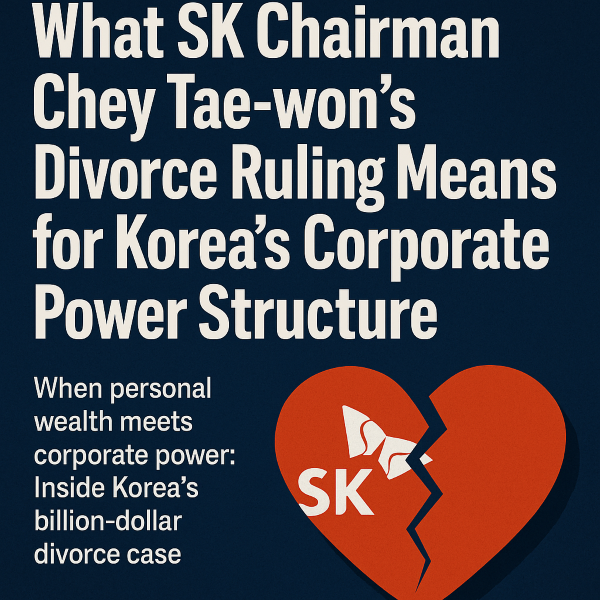
As the Supreme Court prepares to deliver a verdict in the country’s most expensive divorce case, the outcome could reverberate far beyond one family — shaping the future of chaebol governance, succession, and shareholder control in South Korea.
Few legal battles in South Korea have blurred the line between private life and corporate control as sharply as SK Group Chairman Chey Tae-won’s divorce from Noh So-young, director of Art Center Nabi and daughter of former President Roh Tae-woo.
At stake is more than 1 trillion won ($720 million) in asset division — and, potentially, the stability of SK Group, Korea’s third-largest conglomerate. The Supreme Court’s ruling, set for October 16, could either cement the lower court’s decision that included SK Inc. shares in the marital estate or send the case back for retrial, trimming Chey’s financial exposure.
If upheld, the verdict could force Chey to sell a portion of his SK Inc. stake to pay the court-ordered settlement, weakening his control at a time when the group’s ownership structure is already delicately balanced. More than half of his holdings are pledged as loan collateral, and his total combined voting control stands below 26 percent.
That prospect unsettles Korea’s corporate world, where personal wealth and managerial authority are often intertwined. Analysts warn that any reduction in Chey’s equity stake could open the door to shareholder activism or rival influence in a sector long defined by dynastic leadership.
SK’s case also revives broader questions about chaebol governance — how much personal fortune should determine corporate control, and whether family disputes can spill over into boardrooms.
Legal observers note that the court’s reasoning will set a precedent for how marital property and corporate assets are treated under Korean law, particularly when inherited or built through complex holding structures.
Regardless of the verdict, the case has already forced corporate Korea to confront an uncomfortable reality: in a modern economy still dominated by family-run conglomerates, the line between business empire and personal legacy remains as thin as ever.
M. H. Lee (mhlee@koreabizwire.com)