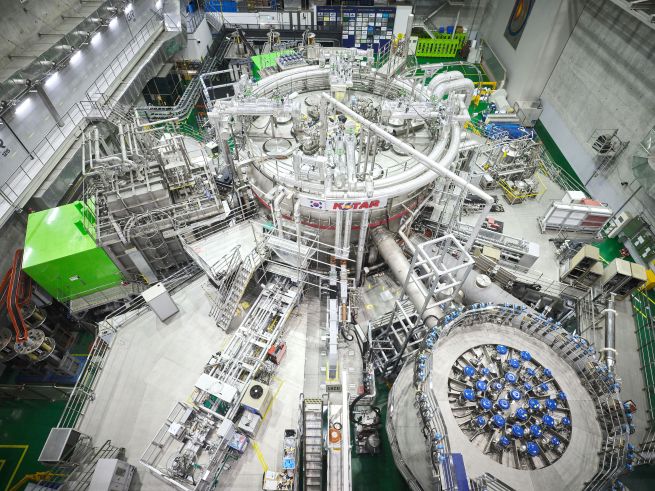
A view of KSTAR (Image courtesy of the Korean Fusion Energy Institute)
DAEJEON, Oct. 27 (Korea Bizwire) — South Korea has launched a new round of plasma experiments on its homegrown nuclear fusion device, KSTAR, as part of a broader push to accelerate the development of fusion energy, researchers said Monday.
KSTAR — short for Korea Superconducting Tokamak Advanced Research — is a superconducting research reactor designed to recreate the sun’s fusion reactions on Earth by confining ultra-hot plasma.
Sustaining that plasma at extreme temperatures remains one of the biggest challenges in turning fusion power into a practical energy source.
The Korean Fusion Energy Institute said the latest experiments, running through December, aim to improve plasma stability in a tungsten-lined environment. Tungsten is used for components that must withstand intense heat, such as the tokamak’s divertor, which protects the reactor’s vacuum vessel.
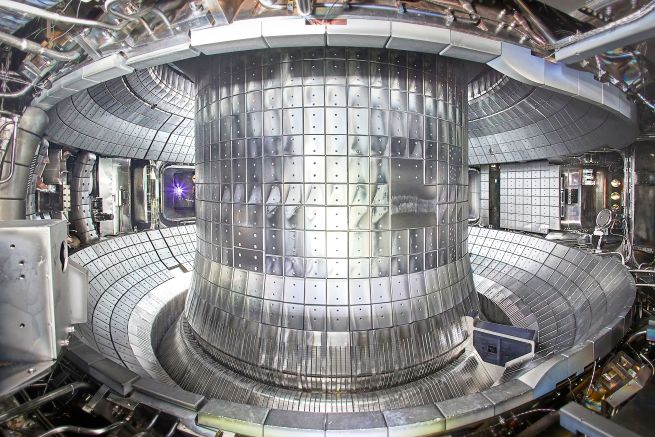
KSTAR Begins Advanced Plasma Tests Aimed at Future Fusion Power
But impurities from the metal can contaminate the plasma and degrade performance, an issue that has become a priority for the global fusion community.
Tungsten will be used for the inner walls of ITER, the international fusion reactor now under construction in France, as well as in future commercial plants, making the work particularly relevant beyond South Korea.
Researchers plan to deploy artificial intelligence and machine-learning systems to rapidly detect and counter changes in the plasma, testing real-time control methods that could help sustain stable fusion conditions for longer periods.
After a brief maintenance period, the team expects to begin its 2026 experiment cycle as early as February — with a full tungsten-tiled interior planned for the next phase.
“Efforts to bring fusion energy closer to commercialization are accelerating worldwide,” said Oh Young-kuk, head of the institute. “KSTAR is moving quickly to secure technologies that could be used directly in future reactors through international collaboration and advanced control techniques.”
Kevin Lee (kevinlee@koreabizwire.com)