YouTubers attempting a 100-hour no-sleep challenge (Image sources: YouTube channels “Go Jaeyoung” (@고재영), “Dambi” (@담비), “OneD1a” (@OneD1a), and “Utchamman” (@웃참맨-d1o), video captures).
The Algorithm Made Them Do It
SEOUL, Oct. 28 (Korea Bizwire) — In South Korea, YouTube creators are testing the limits of their own bodies in pursuit of clicks. The trends are familiar: the more extreme, the better. The less medically sound, the more likely it is to go viral.
One popular creator with more than a million subscribers posted a challenge this year titled “30 Eggs a Day for Seven Days.” It racked up nearly four million views. He ended the week with stomach pain, headaches and a modest drop in weight.
Another channel documented a week of eating nothing but instant noodles. Viewers argued in the comments about whether such a stunt even counts as a “challenge.”
These experiments trace their lineage to “Super Size Me,” the 2004 documentary that chronicled the toll of 30 days of McDonald’s meals. But today’s versions rarely aim for critique or social impact. They simply chase sensation.
Popular titles promise to reveal “What Happens If You Eat Nothing for 20 Days,” or “What Happens When You Don’t Sleep for 100 Hours.” One such fasting video was removed after the creator suffered dizziness and hives and gave up after 15 days. The sleeplessness stunt drew millions of views and a wave of imitators.
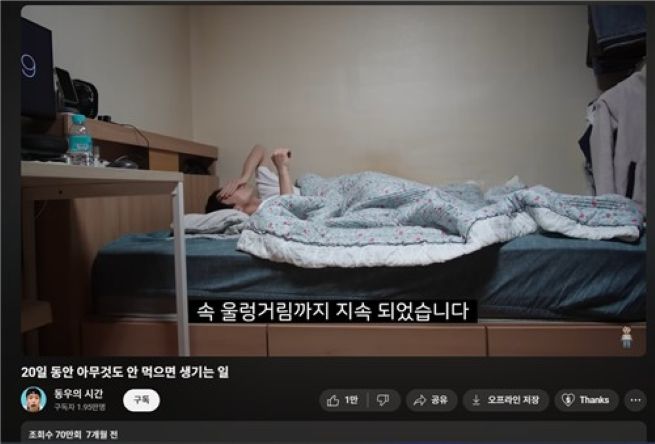
A video documenting a challenge to eat nothing for 20 days (Image source: YouTube channel “Dongwoo’s Time” (@dongwootime), screen capture)
Doctors warn these challenges can quickly move from spectacle to harm. Fasting rapidly strips muscle as the body burns through its energy stores. Extreme sleep deprivation destabilizes the nervous system and spikes blood pressure.
“There is no meaning in taking on a risk that only worsens the odds for your health,” said Yang Sung-kwan, a family medicine specialist. He argues that creators are sacrificing long-term well-being for a burst of short-term attention.
That attention is the point. As audiences become numb to shock, creators escalate. The cycle is structurally reinforced by recommendation algorithms that reward outrage and novelty. And with high engagement comes the next pressure: authenticity.
One YouTuber with 600,000 subscribers recently faced accusations of staging portions of his “survival” videos. His defense? It was just editing to enhance immersion.
The irony is that viewers often respond by trying to one-up the challenges in the comments. “I lived off ramen for two weeks — where’s my YouTube channel?” one wrote.
The entertainment economy continues to push deeper into people’s lungs and stomachs, their sleep patterns and blood chemistry. It is a race that cannot escalate forever. At some point, the influencers stop influencing and start endangering. As one commenter worried on a now-deleted starvation video: “Don’t follow this. Your heart might stop before the views come in.”
Lina Jang (linajang@koreabizwire.com)