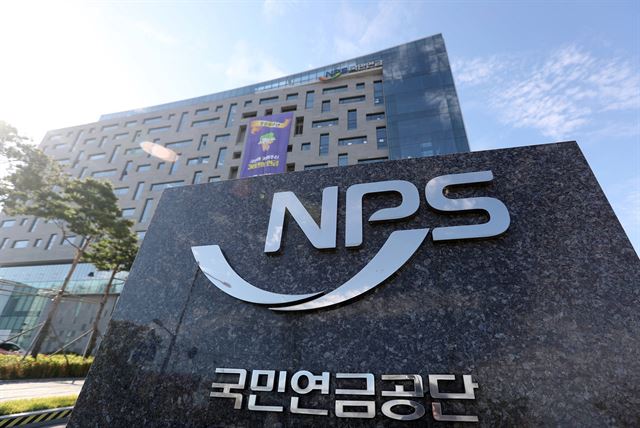
A National Pension Service office in Jeonju, North Jeolla Province. (image: Yonhap)
SEOUL, Nov. 3 (Korea Bizwire) — South Korea’s National Pension Service (NPS) has achieved its highest-ever investment return this year, buoyed by a record-breaking rally in the local stock market that sent its annual yield soaring above 20 percent as of the end of October, according to industry sources.
The fund’s assets under management have surpassed 1,400 trillion won (about US$1.02 trillion), up more than 200 trillion won from the end of last year, marking one of the strongest performances ever recorded by a global pension fund.
Domestic equities were the main driver, returning over 60 percent on the back of surging semiconductor shares such as Samsung Electronics and SK hynix.
Other asset classes, including foreign stocks, bonds, and alternative investments, also delivered positive returns. The NPS’s performance exceeded its benchmark by roughly one percentage point, a rare feat in the global pension sector.
The fund’s results stand out internationally. Major global peers such as Japan’s Government Pension Investment Fund (GPIF), Canada’s CPP Investments, and the California Public Employees’ Retirement System (CalPERS) have posted annual returns of between 6 and 15 percent in recent years.
Analysts say the NPS’s performance, fueled by Korea’s first-ever KOSPI surge past 4,000 points, is virtually unprecedented among the world’s top pension funds.
The bull statue installed in front of the Korea Exchange (Image courtesy of Yonhap)
The strong returns could have far-reaching implications for South Korea’s pension system, whose long-term solvency has been a point of political and fiscal debate. A sustained rise in investment income could delay the projected depletion of the fund, currently estimated for 2057.
According to an analysis commissioned by a Democratic Party lawmaker, if the NPS maintains an average return of 6.5 percent rather than the 4.5 percent assumed in the government’s fiscal projections, the fund’s exhaustion date could be postponed to 2090.
Even after factoring in adjustments for alternative asset valuations, the fund’s gains this year—expected to top 200 trillion won—are three times greater than total annual premium contributions from workers and employers.
“The higher the fund’s actual return, the longer the pension’s sustainability,” said Kim Yong-ha, a pension finance expert at Soonchunhyang University. “The government should revisit the pension’s fiscal structure and update its assumptions to reflect more realistic return scenarios.”
Industry analysts credit the NPS’s performance to strategic exposure to semiconductors, steady returns from overseas equities, and gains in fixed-income and private investments amid easing global monetary conditions. Yet they caution that the extraordinary results underscore the need for greater autonomy and risk diversification to maintain resilience in future cycles.
“The NPS has shown it can compete with the world’s leading funds,” said a former senior investment official. “To sustain that success, the system must ensure investment independence and the flexibility to respond quickly to market changes.”
Ashley Song (ashley@koreabizwire.com)