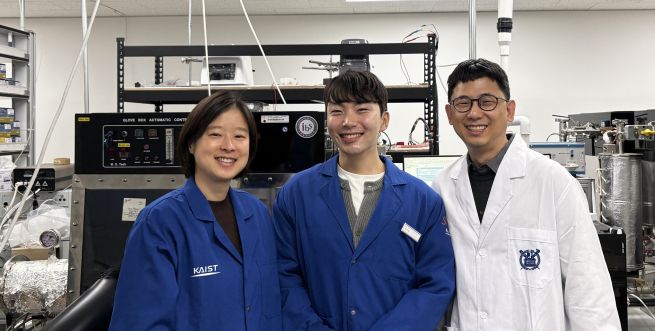
KAIST and Seoul National University Unveil Organic Solid Electrolyte Enabling High-Performance Lithium Metal Cells (Image provided by KAIST)
DAEJEON, Nov. 5 (Korea Bizwire) — South Korean scientists have developed a new organic solid electrolyte film that could accelerate the commercialization of lithium metal batteries, offering a major advance in safety and energy efficiency, researchers said Tuesday.
A research team led by Professor Byun Hye-ryung at the Korea Advanced Institute of Science and Technology (KAIST), in collaboration with Professor Sohn Chang-yoon of Seoul National University, announced that they had created a solid electrolyte film designed to overcome one of the biggest barriers to lithium metal batteries: the risk of fire from conventional liquid electrolytes.
Lithium metal batteries, which replace graphite anodes with lithium metal, can dramatically reduce weight and volume while significantly increasing energy density and driving range—making them one of the most promising next-generation power sources for electric vehicles. However, their reliance on highly flammable liquid electrolytes has long posed a critical safety challenge.
To address this, the researchers engineered a flexible organic solid electrolyte just 20 micrometers thick—about one-fifth the diameter of a human hair—using a new porous material called a covalent organic framework (COF). By arranging lithium-ion-conducting functional groups at precise intervals, the team enabled ions that typically require high temperatures to move efficiently at room temperature.
Molecular dynamics simulations showed that the COF’s structure minimized the energy required for ion transport, allowing lithium ions to travel along the shortest and most direct molecular pathways. The result: ion mobility rates 10 to 100 times faster than existing organic solid electrolytes.
When tested in lithium-metal-based lithium iron phosphate batteries, the new material retained more than 95 percent of its initial capacity after 300 charge-discharge cycles, with a Coulombic efficiency of 99.9 percent—indicating virtually no energy loss.
“This demonstrates that fast lithium-ion transport can be achieved at room temperature using an organic solid electrolyte,” said Professor Byun. “Combining this with inorganic materials could further enhance interfacial stability, moving us closer to practical lithium metal batteries.”
The study was published in the October 5 issue of Advanced Energy Materials.
Kevin Lee (kevinlee@koreabizwire.com)