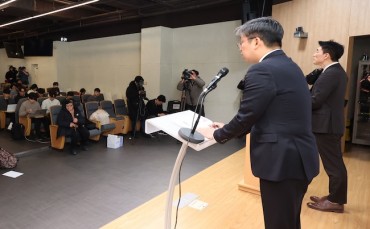
The need to regulate the use of artificial intelligence tools is growing. (Image courtesy of Yonhap)
SEOUL, Nov. 28 (Korea Bizwire) — South Korea will issue its first government-backed ethics guidelines for the use of generative artificial intelligence on university campuses, amid a surge in cheating cases involving AI tools such as ChatGPT.
According to the office of Kim Yong-tae, an opposition lawmaker who sits on the National Assembly’s Education Committee, the Ministry of Education is developing an “AI Ethics Guideline for University Students” in partnership with the Korean Council for University Education.
The guidelines will outline acceptable uses of AI in academic settings while making clear that cheating is prohibited. They are also expected to include strategies for minimizing hallucinations, reducing digital skill gaps among students and encouraging responsible learning practices.
Because academic governance is handled internally by universities, the guidelines will not carry legal force. Still, officials say the framework will provide a national standard that schools can adapt to their own circumstances.
The new initiative follows a series of high-profile cheating scandals at top universities — including Yonsei University, Seoul National University and Korea University — that revealed widespread misuse of AI tools during exams and coursework. The government is currently analyzing these cases and plans to gather input from professors and students later this year.
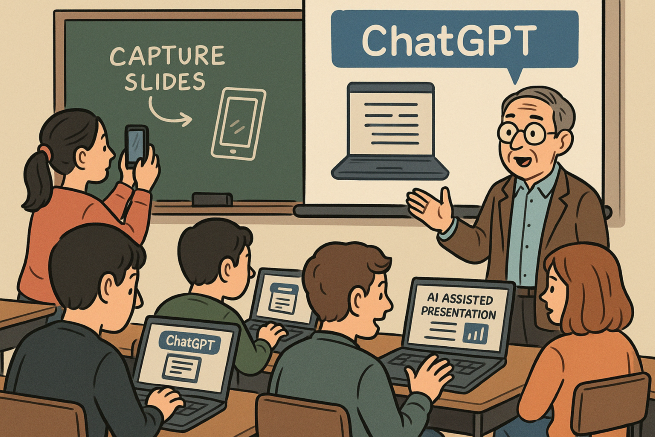
Generative AI tools like ChatGPT are no longer a novelty — they’ve become the academic norm. (Image created by AI/ChatGPT)
Officials also intend to commission a research project early next year, drawing on domestic experts and international examples, such as policies used at Harvard University. The guidelines may be divided into versions for faculty and for students.
Although the Education Ministry issued a set of AI ethics principles in 2022, those guidelines focused largely on privacy and data transparency and were widely criticized as too abstract.
The new framework marks the first attempt to directly address how generative AI should — and should not — be used in classrooms, assignments and research.
The government is separately seeking budget approval for an initiative to fund AI courses, proposing 3 billion won per university for 30 institutions next year.
Experts say the guidelines should clearly define what constitutes AI-enabled misconduct while also encouraging productive and transparent use. “We need clear standards for what counts as AI plagiarism,” said Song Ki-chang, a professor of education at Sookmyung Women’s University.
Others argue the framework should address broader issues such as transparency, trust and academic freedom while allowing universities to set detailed rules tailored to their needs.
M. H. Lee (mhlee@koreabizwire.com)