A school shuttle bus parked at an English kindergarten in Seoul’s Gangnam District (Yonhap)
SEOUL, Dec. 29 (Korea Bizwire) — A new law banning English level tests for preschool children has ignited a sharp debate among parents in Seoul’s education hubs, exposing deep divisions over early childhood education and the future of private English instruction.
Earlier this month, the National Assembly passed a bipartisan amendment to the Private Education Act prohibiting English academies from administering placement tests to children aged 3 to preschool entry.
Often referred to as the “age four and seven exams (Entrance Exams for 4 and 7-Year-Olds),” the tests have long been criticized for fueling anxiety among young children and intensifying competition among families.
Under the revised law, academies may not conduct exams or assessments for admission or class placement. Violators face penalties, including business suspension or fines. Limited observational evaluations are allowed only after enrollment and with parental consent, strictly for educational support.
In Seoul’s Mok-dong district, a hub for elite English kindergartens, several prominent academies said they had already stopped conducting formal tests. Instead, they now rely on parent consultations and age-based class placement. “We don’t do level tests anymore because of government regulations,” said one academy administrator, adding that children are grouped by age rather than proficiency.

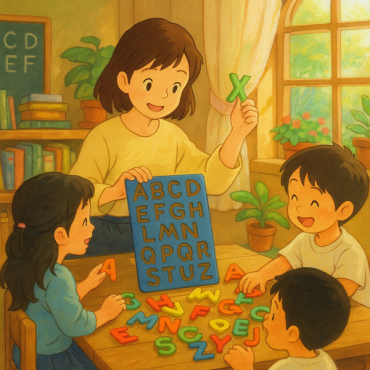
English learning materials for young children
Still, parents remain split.
Some argue that level testing is necessary to ensure effective learning. “If you’re paying high tuition, you want your child learning with peers at a similar level,” said one parent whose seven-year-old attends an English kindergarten. Others welcomed the ban, recalling the stress tests placed on both children and parents. “My child took the test, but honestly, I was more nervous than they were,” another parent said. “I’m relieved it’s being abolished.”
Even those on opposing sides share a common concern: enforcement. Parents worry that academies may simply rebrand tests as “trial classes” or informal interviews, undermining the law’s intent. Online parenting forums are already buzzing with speculation that assessments will continue covertly.
Education experts echo those concerns while cautioning against excessive early instruction. “Early exposure to intensive English testing may improve pronunciation but often backfires later by reducing motivation,” said Han Moon-seop, an emeritus professor of English education at Hanyang University. He warned that legal bans alone could lead to new loopholes unless parental anxiety around early education is also addressed.
“The key,” he said, “is reassuring parents that early English acceleration does not guarantee long-term advantage.”
As the law takes effect, the debate underscores a broader challenge for South Korea: balancing parental expectations, private education markets, and the well-being of its youngest learners. Whether the ban leads to meaningful change—or simply new workarounds—remains an open question.
M. H. Lee (mhlee@koreabizwire.com)