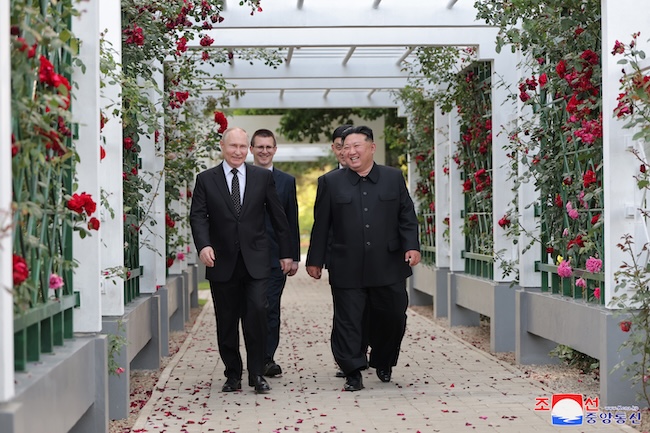
North Korean leader Kim Jong-un (R) and Russian President Vladimir Putin walk side by side in a garden in Pyongyang following the signing of a comprehensive strategic partnership treaty, in this photo published by the Korean Central News Agency on June 20, 2024. (Image courtesy of Yonhap)
SEOUL, Dec. 29 (Korea Bizwire) — South Korea’s defense minister warned on Monday that the security environment surrounding the Korean Peninsula was becoming increasingly volatile, pointing to deepening military cooperation between North Korea and Russia as a destabilizing force with global implications.
Speaking at a forum on South Korea’s alliance with the United States, Defense Minister Ahn Gyu-back said Pyongyang was accelerating its nuclear and missile programs while simultaneously modernizing its conventional forces through growing ties with Moscow.
“The security situation around the Korean Peninsula has become more unstable than at any point in recent years,” Mr. Ahn said, describing the cooperation between North Korea and Russia as a “grave challenge” not only for the peninsula but for the international community at large.
South Korea’s intelligence agency has estimated that North Korea has dispatched roughly 15,000 troops to Russia since October of last year to support Moscow’s war in Ukraine. In return, Seoul believes Pyongyang may be gaining access to advanced Russian military technologies, raising concerns that the partnership could significantly enhance North Korea’s strategic capabilities.
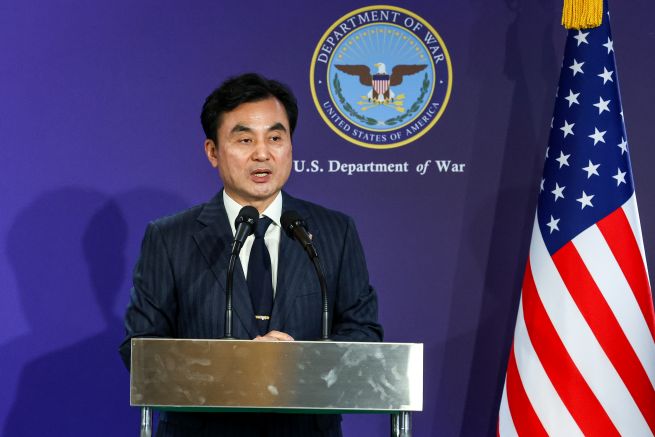
South Korean Defense Minister Ahn Gyu-back speaks during a joint press conference with U.S. Defense Secretary Pete Hegseth after they concluded the 57th Security Consultative Meeting at the defense ministry in Seoul, in this file photo from Nov. 4, 2025. (Pool photo) (Yonhap)
Those concerns were sharpened last week when North Korean state media released photographs of the country’s leader, Kim Jong-un, inspecting a shipyard where an 8,700-ton nuclear-powered submarine was under construction — an image widely interpreted as a signal of the regime’s ambitions to expand its nuclear deterrent.
Mr. Ahn urged South Korea and the United States to respond to the evolving security landscape with unity and resolve, emphasizing the importance of close coordination between the allies.
“Grounded in firm mutual trust and understanding, South Korea and the United States must continue to work together to overcome the security challenges we face,” he said.
The remarks reflect growing anxiety in Seoul that the convergence of North Korean weapons development and Russian military support could reshape the region’s balance of power at a moment when global security tensions are already running high.
M. H. Lee (mhlee@koreabizwire.com)