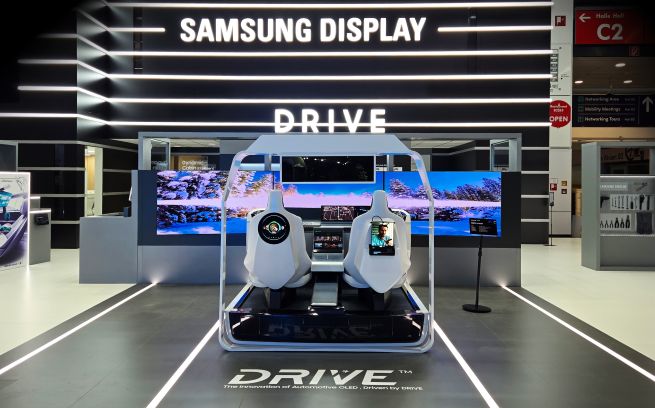
Samsung Display participated as the only global panel maker at IAA Mobility 2025, the world’s largest mobility exhibition, held in Munich, Germany, from Sept. 9 to 14, 2025 (local time), where it unveiled a wide range of automotive organic light-emitting diode (OLED) solutions. The photo shows Samsung Display’s newly introduced “digital cockpit” at IAA Mobility 2025. (Photo courtesy of Samsung Display)
SEOUL, Dec. 30 (Korea Bizwire) — Samsung Electronics is deepening its long-running partnership with BMW by expanding cooperation from batteries and displays into automotive semiconductors, underscoring Chairman Lee Jae-yong’s push to position vehicle electronics as a core growth engine for the group.
Under the latest agreement, Samsung will supply its in-house automotive processor, Exynos Auto, for BMW’s upcoming New iX3 model.
The chip, designed for in-vehicle infotainment systems, marks Samsung’s first meaningful semiconductor collaboration with a global premium automaker, complementing its existing role as a supplier of high-performance electric-vehicle batteries and automotive displays.
Samsung’s relationship with BMW dates back more than 15 years. Since a joint electric-vehicle development project began in 2009, Samsung SDI batteries have been installed in BMW’s major EV lineup, from the i3 and i8 to the iX, i4 and the flagship i7.
The addition of semiconductors signals a strategic broadening of that alliance at a time when software-defined vehicles and advanced electronics are becoming central to automaker competitiveness.
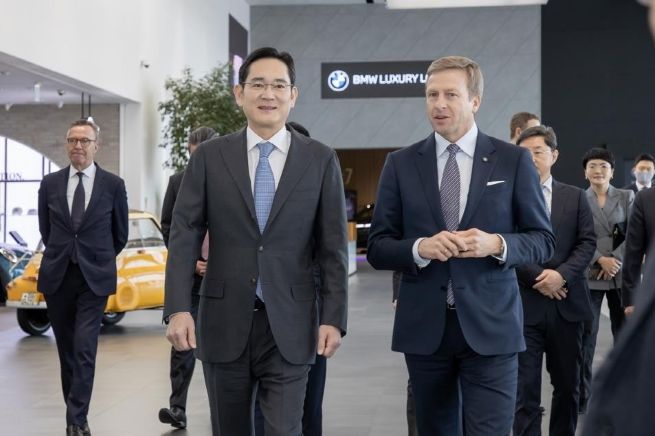
A scene from the 2022 meeting between Samsung Electronics Chairman Lee Jae-yong and BMW Group CEO Oliver Zipse during Zipse’s visit to South Korea. (Photo courtesy of Samsung Electronics)
The move reflects a broader groupwide strategy to build an integrated automotive electronics ecosystem. Samsung’s portfolio now spans EV batteries, vehicle displays, digital cockpits and audio systems through its Harman subsidiary, and increasingly, custom automotive chips.
The company’s System LSI division has recently established a dedicated team to develop tailored system-on-chips not only for big tech clients but also for automakers seeking customized solutions.
Chairman Lee has taken a hands-on role in advancing these partnerships, personally meeting executives from BMW, Mercedes-Benz, BYD and Xiaomi over the past year to explore collaboration in vehicle electronics.
Samsung has also bolstered its capabilities through acquisitions, including Harman’s recent purchase of an advanced driver-assistance systems business from Germany’s ZF Friedrichshafen.
Industry analysts say the BMW deal highlights Samsung’s ambition to emerge as a major player in automotive semiconductors, a market gaining importance as electric vehicles and software-driven architectures spread.
With automakers in Europe and China seeking diversified chip suppliers, Samsung is expected to pursue further partnerships beyond BMW as it scales its automotive semiconductor business.
Kevin Lee (kevinlee@koreabizwire.com)