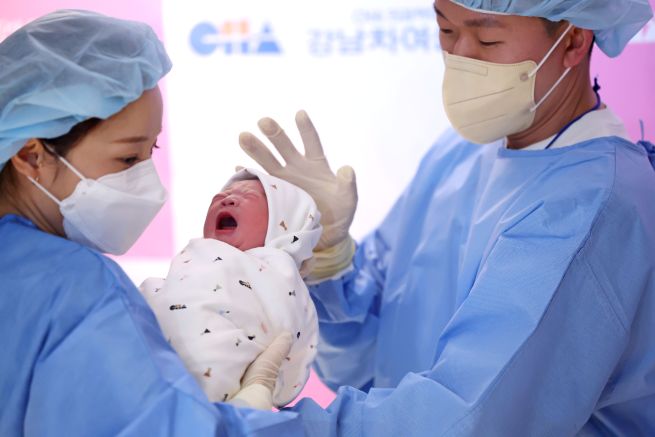
On Jan. 1, the first day of the New Year 2026, the Year of the Byeong-o (Fire Horse), Yoon Sung-min (right) holds Jjaem-i — the baby girl’s prenatal nickname — who was born to him and his wife, Hwang Eun-jung, at Gangnam CHA Women’s Hospital in Seoul. (Yonhap)
SEOUL, Jan. 28 (Korea Bizwire) — South Korea recorded its fastest increase in births in nearly two decades last year, offering a rare note of demographic optimism in a country long defined by declining fertility.
According to government data released Wednesday, 233,708 babies were born between January and November 2025, a rise of 6.2 percent from the same period a year earlier. It was the sharpest year-on-year increase since 2007, the Statistics Ministry said.
Officials expect the total number of births for 2025 to exceed 238,000, marking the second consecutive annual increase after years of steady decline.
In November alone, 20,710 babies were born, up 3.1 percent from a year earlier and the highest November figure since 2019, before the pandemic disrupted family formation. The data suggests that births have been gradually recovering toward pre-pandemic levels, with monthly increases continuing since July 2024.
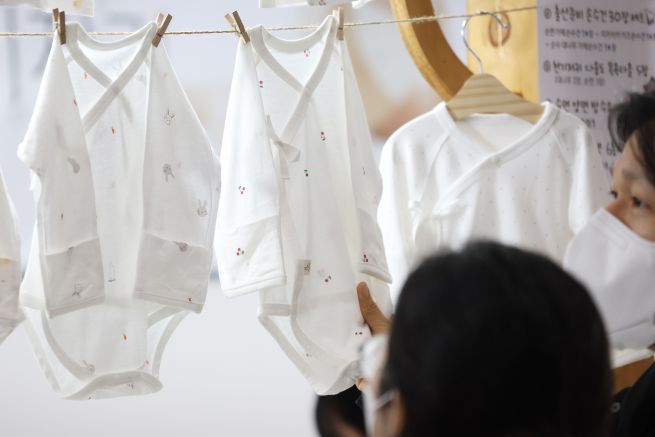
Expectant parents browse baby clothes at the “2026 Moms Holic Baby Fair,” held on Jan. 15 at COEX in Gangnam District, Seoul. (Yonhap)
The country’s total fertility rate — the average number of children a woman is expected to have over her lifetime — edged up to 0.79 in November, an increase of 0.02 from a year earlier. While still the lowest among advanced economies, the rise marked a modest reversal after years of record lows.
Government officials attributed the uptick largely to a sustained increase in marriages, alongside expanded policy support for childbirth and a demographic shift as more women enter their early 30s, the age group most likely to have children.
In South Korea, where childbirth outside marriage remains uncommon, changes in marriage trends tend to be reflected in birth statistics with a delay. That pattern appears to be re-emerging.
Marriages in November rose 2.7 percent from a year earlier to 19,079, extending a growth streak to 20 consecutive months. Divorces, by contrast, fell 9.8 percent to 6,890 during the same period.
Despite the rebound in births, the country’s broader demographic challenge remains intact. Deaths increased 4.9 percent in November to 30,678, resulting in a natural population decline of 9,968 — a reminder that even as births inch upward, South Korea continues to age faster than it can replace itself.
For policymakers, the figures offer cautious encouragement rather than a turning point: a signal that demographic decline may be slowing, even if it is far from being reversed.
Lina Jang (linajang@koreabizwire.com)