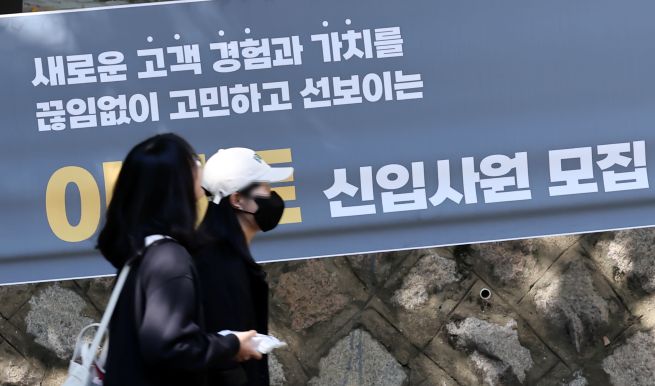
A recruitment banner announcing openings for new employees (Yonhap)
SEOUL, Feb. 2 (Korea Bizwire) — New university graduates in South Korea earn significantly higher starting salaries than their counterparts in Japan and Taiwan, according to a comparative study released Sunday by the Korea Employers Federation.
The analysis, which adjusted wages using purchasing power parity exchange rates, found that entry-level pay for Korean college graduates was 24.5 percent higher than in Japan and 41.1 percent higher than in Taiwan.
Based on data from companies with 10 or more employees, the average annual starting salary for Korean graduates was estimated at $46,111, compared with $37,047 in Japan. The gap widened with company size: at large corporations, Korean graduates earned about $55,161, more than 40 percent higher than the $39,039 earned by their Japanese counterparts.
Across 10 comparable industries, Korean starting pay exceeded Japan’s in nine, with the largest gaps seen in finance and insurance, professional and scientific services, and manufacturing. Japan posted slightly higher wages only in the accommodation and food services sector.
The disparity was even more pronounced in comparisons with Taiwan. Korean graduates earned an average of $42,160, compared with $29,877 in Taiwan, a difference of more than 41 percent. In all 17 comparable industries, Korean starting salaries were higher, with especially wide gaps in construction, utilities and professional services.

Across 10 comparable industries, Korean starting pay exceeded Japan’s in nine, with the largest gaps seen in finance and insurance, professional and scientific services, and manufacturing. (Yonhap)
Even when calculated using market exchange rates rather than purchasing power parity, Korean entry-level pay remained markedly higher, exceeding Taiwan’s by more than 90 percent.
The federation said the findings highlight structural challenges in South Korea’s labor market, where relatively high starting wages are combined with seniority-based pay systems and strong union pressure for uniform wage increases — reinforcing a high-wage structure concentrated in large corporations.
Ha Sang-woo, head of economic research at the federation, cautioned that extending the statutory retirement age to 65 should be considered carefully, arguing that broader labor reforms — including wider adoption of job- and performance-based wage systems — should come first.
The report adds to ongoing policy debate over wage rigidity, labor costs and long-term competitiveness as South Korea confronts slowing growth and demographic pressures.
Ashley Song (ashley@koreabizwire.com)