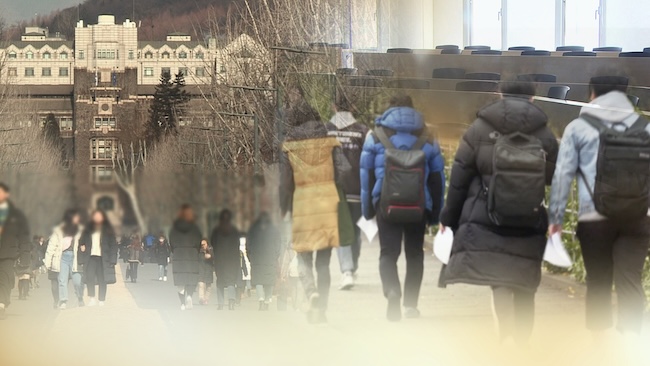
South Korea’s universities face mounting financial challenges as the number of incoming students declines and dropout rates rise. (Image courtesy of Yonhap)
SEOUL, Jan. 20 (Korea Bizwire) — South Korea’s universities face mounting financial challenges as the number of incoming students declines and dropout rates rise. Many institutions, particularly private universities in Seoul, are debating strategies to address the crisis, including tuition hikes and increased reliance on government funding.
According to data released on Sunday by the Korea Educational Development Institute, freshman enrollment rates have remained below 100% since 2005, reflecting a two-decade struggle to fill class capacities. While the rate saw a brief recovery to 98% in 2024 after falling to 94.9% during the COVID-19 pandemic in 2021, the persistent decline in South Korea’s school-age population leaves the future uncertain.
Retention rates among enrolled students show a similar pattern. The proportion of students remaining in school compared to institutional capacity dropped from 113.5% in 2019 to 109.9% in 2024. Concurrently, the academic dropout rate for undergraduate students hit 5.3% in 2023, the highest since records began in 1999.
These trends exacerbate financial difficulties for universities, especially private institutions that rely on tuition for approximately half of their revenue. Shrinking enrollment directly impacts operational sustainability, forcing many universities to weigh government-backed tuition freezes against independent fee increases.
Despite government pressure to maintain tuition levels, some private universities, including Sogang University, Kookmin University, and Inje University, have opted for modest increases, citing the need to stabilize finances. However, public universities, such as nine major national institutions and Incheon National University, have adhered to the freeze to align with government-funded projects.
Recruiting international students, exempt from strict enrollment and tuition regulations, is emerging as a viable solution. The number of foreign undergraduate students in South Korea nearly tripled from 32,101 in 2014 to 93,624 in 2024. University leaders have identified foreign student enrollment as a top priority, second only to domestic student recruitment.
“Foreign students have significantly boosted tuition revenues,” a representative from a private university noted. “We plan to diversify and enhance efforts to attract more international students.”
The crisis underscores the urgent need for strategic reforms as universities navigate demographic shifts and financial instability. While some institutions experiment with tuition adjustments, others explore long-term solutions to attract both domestic and international students, striving to maintain sustainability in an evolving educational landscape.
Ashley Song (ashley@koreabizwire.com)