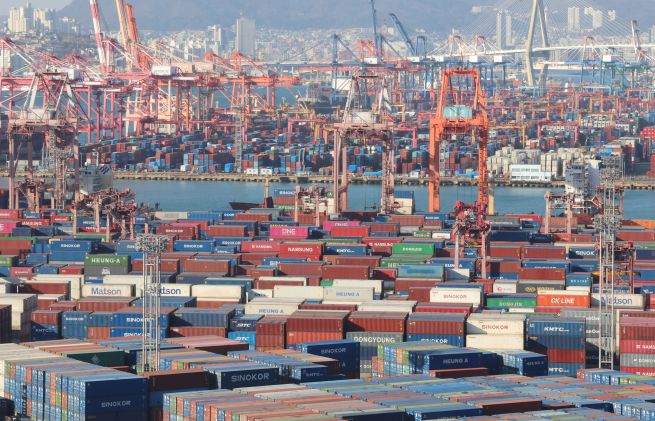
A view of Busan Port filled with containers (Image courtesy of Yonhap)
SEOUL, Feb. 4 (Korea Bizwire) — South Korea’s economic outlook is growing increasingly uncertain as global trade tensions intensify, raising concerns that the country’s real GDP growth rate could fall to the mid-1% range this year.
Compounding the risks of domestic political instability, the latest wave of U.S. tariff hikes on key trading partners has further darkened South Korea’s economic prospects. According to the Bank of Korea (BOK), the central bank had already identified escalating global trade frictions as a major downside risk in its November 2024 economic forecast, labeling it as “Scenario 2.”
At the time, the BOK projected South Korea’s economy to expand by 1.9% in 2025 but warned that heightened trade conflicts between major economies such as the U.S. and China could shave an additional 0.2 percentage points off growth.
“If the U.S. strengthens its protectionist stance and major economies like China respond in kind, global trade will contract sharply, exacerbating policy uncertainty,” the BOK stated. “This could also trigger financial market instability through a widening risk premium.”
These concerns are now becoming reality. U.S. President Donald Trump recently signed an executive order imposing a 10% tariff on Chinese imports and 25% duties on goods from Canada and Mexico. In response, these countries have signaled retaliatory measures, raising fears of a full-scale trade war.
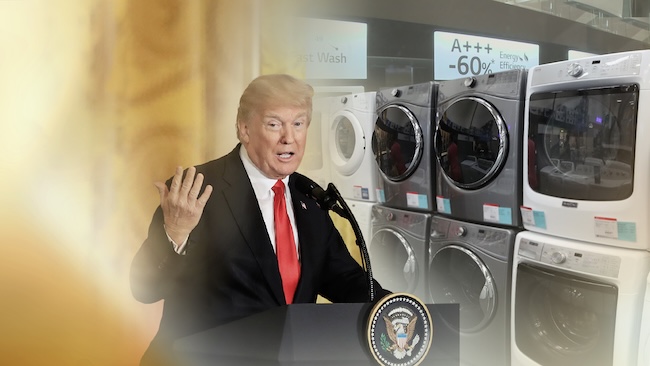
Industry observers are particularly concerned about Trump’s campaign promise to impose a universal 10-20% tariff on all imports, which could affect the entire range of consumer electronics. (Image courtesy of Yonhap)
Worryingly, the BOK’s previous forecasts may not have fully accounted for this rapidly escalating situation. The central bank recently revealed that when it held its key interest rate steady on January 16, it had already adjusted its 2025 growth assumption to a lower range of 1.6%–1.7%—down from the original 1.9% projection.
However, this revision only partially factored in the economic risks posed by U.S. trade policies.
Further concerns emerged after Trump reaffirmed his commitment to additional tariffs against China and other trading partners at the end of January. As a result, analysts speculate that the BOK’s revised economic forecast, set for release on February 25, could downgrade South Korea’s growth projection to as low as 1.5%—or even lower.
International investment banks have already begun slashing their forecasts. Citi recently lowered its estimate for South Korea’s 2025 growth from 1.5% to 1.4%, while JP Morgan revised its projection from 1.3% to 1.2%.
Capital Economics has set its forecast at just 1.1%. As a result, the average projection from major investment banks, which stood at 1.7% at the end of 2024, may soon dip to 1.6% or below.
According to the International Finance Center, Citi estimates that the latest U.S. tariffs on China, Canada, and Mexico could reduce South Korea’s GDP by 0.22%–0.44%, with key industries such as automotive parts, steel, and machinery bearing the brunt of the impact.
Despite mounting concerns, the possibility remains that the so-called “tariff war” could either escalate further or be resolved through negotiations.
A BOK official stated, “We have not yet reached the ‘Scenario 2’ conditions outlined in the November forecast. Given the fluidity of the current situation, we must wait until February 25 to see how our economic outlook will evolve.”
With trade uncertainties looming and investment banks adjusting their expectations downward, South Korea faces a critical period ahead as it navigates the turbulence of global economic shifts.
M. H. Lee (mhlee@koreabizwire.com)