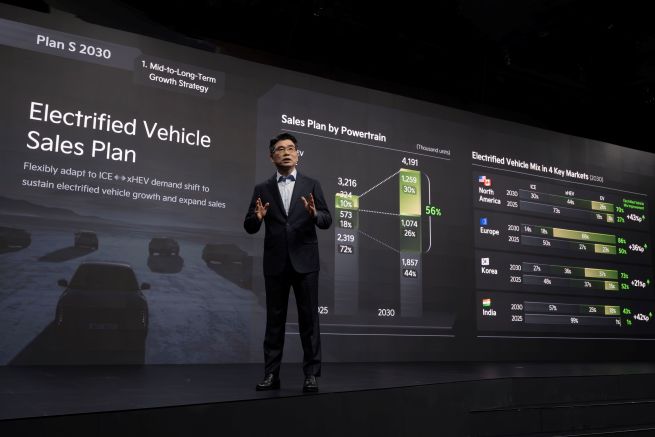
Kia President Song Ho-sung speaks about the company’s mid-to-long-term business strategy and financial goals at the “2025 CEO Investor Day” held at the Shilla Hotel in Jung District, Seoul, on April 9, 2025. (Image provided by Hyundai Motor and Kia)
SEOUL, April 21 (Korea Bizwire) — As global automakers confront slowing demand for fully electric vehicles (EVs), South Korean carmakers Kia and Hyundai are turning to range-extended electric vehicles (EREVs) to bridge the adoption gap and unlock new revenue streams for the struggling battery industry.
Kia revealed it is developing an EREV pickup model alongside its upcoming all-electric pickup aimed at the U.S. market. “If EVs alone cannot meet market demands, we are preparing EREVs as a complementary solution,” Kia President Song Ho-sung said during the company’s 2025 CEO Investor Day.
Hyundai is also accelerating development of EREVs, with plans to debut models in North America and China by late 2026 and begin mass sales in 2027.
EREVs operate primarily as EVs but feature a small internal combustion engine that serves as a generator when battery levels drop. With battery packs typically 50–70% the size of those in full EVs, EREVs offer lower price points and greater convenience in regions with underdeveloped charging infrastructure.
The segment is already gaining traction in China. According to LMC Automotive, sales of EREVs in China more than doubled in 2024 to 1.31 million units, up from 650,000 in 2023. Leading Chinese manufacturers like Li Auto, Seres, and Changan sold hundreds of thousands of EREVs last year alone.
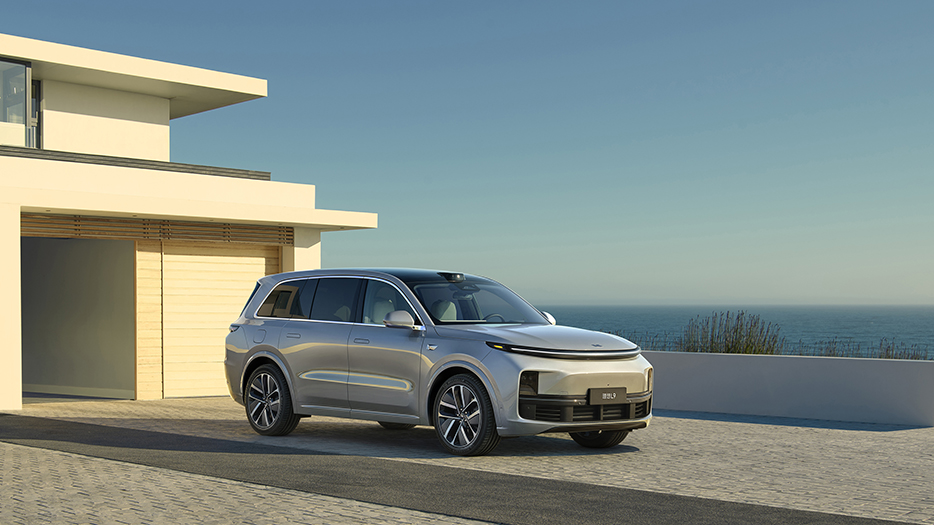
Li Auto’s Li L9 in China (Image captured from Li Auto’s official website)
Global players are following suit. Stellantis’ RAM brand will release its Ramcharger 1500 EREV pickup later this year, while Ford is preparing a range-extended version of its Transit commercial van by 2027.
Analysts view EREVs as a transitional technology, likely to replace plug-in hybrid vehicles (PHEVs), which use much smaller battery packs. Since EREVs require more battery capacity—often double that of PHEVs—they present a near-term opportunity for battery makers facing EV headwinds.
Industry leaders like LG Energy Solution, Samsung SDI, and SK On are reportedly in talks with major automakers planning EREV launches. SK On has already stated it is actively preparing EREV battery solutions in alignment with Hyundai’s strategy.
However, not all outlooks are bullish. Experts caution that while EREVs may soften the current EV market slump, they could also delay the broader shift to fully electric mobility, potentially pushing back the battery industry’s long-anticipated boom.
“EREVs present a welcome opportunity during this EV market plateau,” said Lee Jeong-doo, Battery Program Director at the Korea Institute for Advancement of Technology. “But if they slow down full EV adoption in the long run, the impact on the battery industry may be more mixed than optimistic.”
Market Research Intellect forecasts that the global EREV market will grow at a compound annual rate of 20%, reaching $518 billion by 2031.
Kevin Lee (kevinlee@koreabizwire.com)