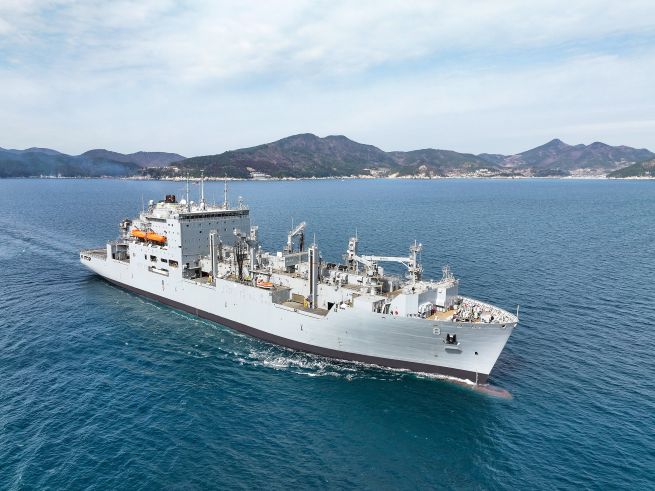
The U.S. Navy’s logistics support ship, USNS Wally Schirra, has departed after completing maintenance and repair work—the first such project awarded to a South Korean company.
The photo shows the USNS Wally Schirra setting sail after successfully undergoing maintenance, a project completed by Hanwha Ocean. (Image courtesy of Hanwha Ocean)
SEOUL, May 4 (Korea Bizwire) — As the second Trump administration signals renewed interest in U.S.-Korea collaboration in shipbuilding, South Korea is eyeing an opportunity to revitalize its maritime industry.
However, analysts warn that meaningful gains will require overcoming major domestic obstacles, including limited U.S. infrastructure and an acute labor shortage at home.
According to a report released May 4 by the Korea International Trade Association (KITA), South Korea ranked second globally in shipbuilding orders for the sixth consecutive year in 2024, with a 16.7% share—well behind China’s 70.6% but far ahead of Japan’s 4.9%.
South Korea’s strength remains in high-value ships such as LNG carriers and ultra-large container vessels. These helped boost the country’s ship exports by 17.6% last year, reaching $25.64 billion (about 36 trillion won).
The U.S. has become an increasingly promising market as Washington moves to bolster its domestic shipbuilding capacity and reduce dependence on Chinese vessels.
Bipartisan lawmakers in Congress have reintroduced the SHIPS for America Act, aimed at revitalizing the American maritime industry through tax incentives, public-private funds, and a ten-year plan to assemble a 250-ship commercial fleet.
Notably, the bill includes a provision allowing certain foreign-built ships to be considered U.S.-built—potentially opening the door for greater cooperation with South Korean firms. The Wall Street Journal recently reported that the Philadelphia Navy Yard, acquired by Hanwha Ocean in 2024, could benefit from increased demand if the bill passes.
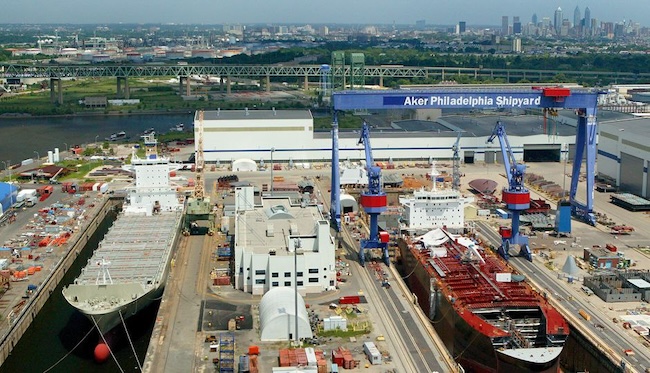
This photo provided by Hanwha Group shows a panoramic view of Philly Shipyard Inc. in Philadelphia, Pennsylvania. (Image courtesy of Yonhap)
South Korea is already establishing a foothold in the U.S. Navy’s maintenance, repair, and overhaul (MRO) market. Last July, HD Hyundai Heavy Industries and Hanwha Ocean signed Maintenance Ship Repair Agreements (MSRAs) with the U.S. Navy, following Japan’s Mitsubishi Heavy Industries. The U.S. Navy currently operates 149 active ships, and its annual MRO budget reaches between $6 billion and $7.4 billion.
Hanwha Ocean aims to win MRO contracts for up to six ships this year, while HD Hyundai targets two to three. According to KOTRA, a successful expansion into the American shipbuilding and MRO sector could invigorate the broader “K-shipbuilding ecosystem,” including smaller partner companies.
The shift coincides with increased demand for LNG carriers and offshore drilling ships, spurred by the Trump administration’s push to expand domestic oil and gas production. The $44 billion Alaska LNG development project, now advancing again, is expected to heighten demand for Korean-built vessels.
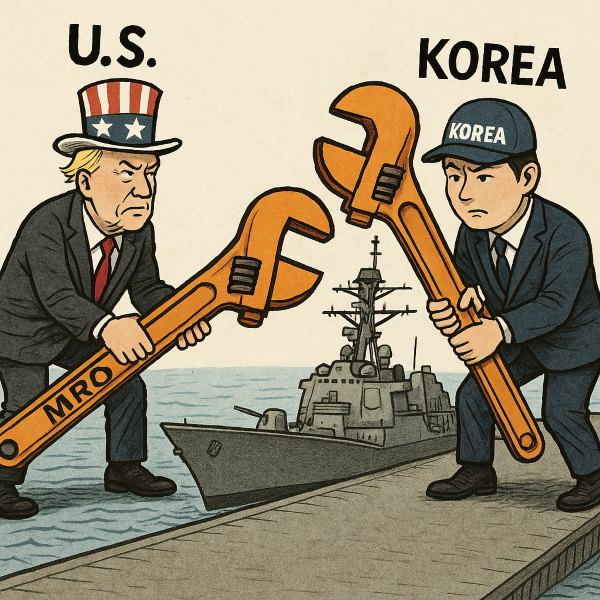
Amid Washington’s push to rebuild domestic fleets, Korean yards seek MRO deals and LNG ship orders—while grappling with labor shortages and policy hurdles. (Image created by ChatGPT)
Further bolstering optimism, the U.S. Congressional Budget Office forecasts that the Navy will allocate roughly $30 billion (about 42 trillion won) annually through 2054 to procure new ships—another potential boon for Korea’s shipbuilders.
Still, challenges remain. KITA notes that while South Korean firms are exploring U.S. investments, they face barriers such as outdated local infrastructure, limited shipyard capacity, supply chain bottlenecks, and higher costs. Protectionist sentiment in the U.S., political concerns over technology transfer, and the potential imposition of tariffs on imported steel, engines, and generators also pose risks.
“South Korea’s shipbuilding industry is structurally constrained by uneven demand, skilled labor shortages, and stagnant tech investment,” said Han Ah-reum, a senior researcher at KITA. “To seize this opportunity, we must enhance our MRO capabilities, expand R&D personnel, and secure strategic government support in tax and budget policies.”
With global demand rising and U.S. cooperation in motion, Korea’s shipbuilding revival is within reach—but far from guaranteed.
M. H. Lee (mhlee@koreabizwire.com)