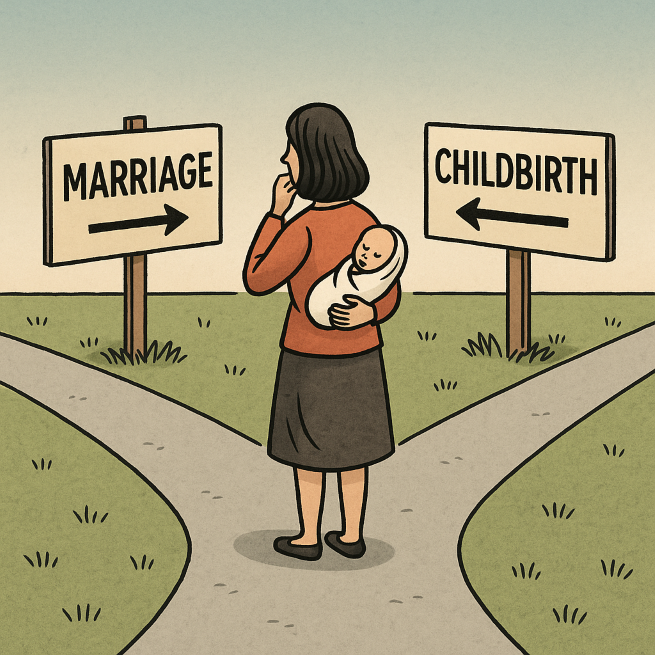
South Korea Considers Legal Support for Childbirth Outside Marriage (Image supported by ChatGPT)
SEOUL, May 8 (Korea Bizwire) — South Korea’s Ministry of Health and Welfare announced plans on Thursdsay to introduce policies supporting childbirth outside of marriage, signaling a potential shift in a country where traditional family structures have long dominated social norms.
First Vice Health Minister Lee Ki-il stated during a radio interview on Parents’ Day that the government would work to create a legal and policy framework allowing people to “have children without getting married.” His remarks come as the country continues to grapple with one of the world’s lowest fertility rates and seeks broader social reforms to address its demographic decline.
Citing 2022 data from the Organisation for Economic Co-operation and Development (OECD), Lee noted that non-marital birth rates in France (65.2%), Sweden (57.8%), and the U.K. (51.4%) sharply contrast with South Korea’s rate of just 3.9% in the same year — a figure that inched up to 4.7% in 2024.
Lee suggested that rising marriage rates last year may contribute to a modest rebound in the nation’s fertility rate. According to Statistics Korea, 20,035 babies were born in February 2025, up 3.2% from a year earlier, while the number of marriages rose 14.3% to 19,370 cases in the same month.
However, Lee emphasized that addressing low birthrates requires more than encouraging marriage. “The fertility issue is not just the Welfare Ministry’s responsibility — it’s a national concern,” he said, calling for systemic support for childbearing regardless of marital status.
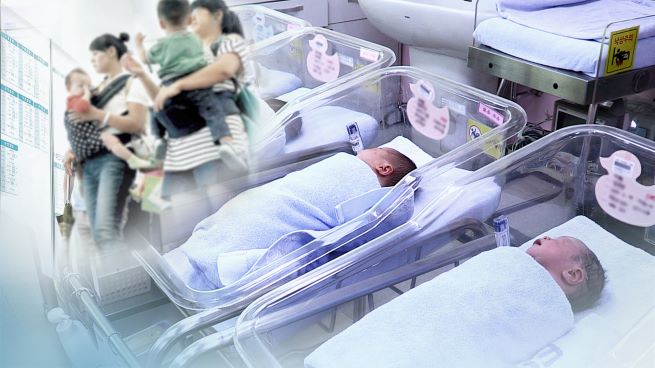
70 pct of S. Koreans believe couples can live together without tying the knot. (Yonhap)
While the Health Ministry clarified that the proposed shift does not promote non-marital childbirth per se, it aims to eliminate discrimination in parenting and maternity support for unmarried individuals. “We are exploring policy solutions to ensure unmarried parents are not excluded from existing benefits,” an official said.
Legal and social barriers remain significant. Under current South Korean law, benefits such as paid maternity leave are only extended to legally married or common-law spouses. Scholars have also raised concerns that children born outside of marriage still face legal and social discrimination.
“There are no institutional options in Korea for families outside of legal marriage,” said Song Hyo-jin, a family policy expert at the Korean Women’s Development Institute. Speaking at a recent seminar hosted by the Korean Peninsula Population Institute for Future, Song criticized the lack of protections and support for diverse family structures.
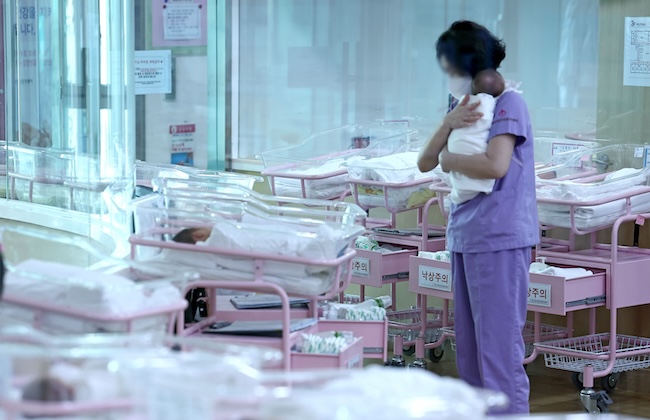
A worker holds a baby at a public postnatal care center in Seoul in this file photo taken Dec. 26, 2023. (Image courtesy of Yonhap)
Though the government first acknowledged non-marital births in its 2018 low birthrate policy roadmap, attempts to legislate inclusive maternity and parental support have stalled. A bill introduced in the 21st National Assembly aimed to extend pregnancy and childbirth assistance regardless of marital status, but it lapsed without a vote before the legislative session ended.
As public attitudes shift and demographic pressures mount, the push for more inclusive family policies appears to be gaining momentum — but whether that momentum will translate into meaningful legal change remains uncertain.
M. H. Lee (mhlee@koreabizwire.com)