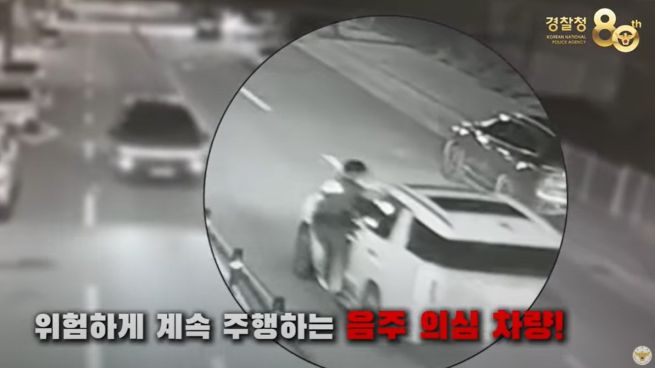
A driver fleeing while dragging a police officer who approached for a sobriety test (Image source: National Police Agency YouTube capture).
SEOUL, Sept. 29 (Korea Bizwire) — Obstruction of official duties against South Korean police officers remains alarmingly frequent, with more than 9,000 cases recorded last year — nearly 25 incidents every day — according to newly disclosed government data.
Figures released by Rep. Seo Beom-soo of the People Power Party, citing the National Police Agency, show that of 9,806 obstruction cases filed in 2024, 92 percent involved interference with police work.
Among 9,481 suspects, nearly 78 percent were intoxicated. Offenders were most commonly in their 50s (26 percent), followed by those in their 40s (23 percent). Teenagers accounted for about 3 percent, though children under 14 — exempt from criminal liability under Korean law — were not included.
The confrontations range from violent assaults to mocking stunts. In July, a drunk driver in Cheonan dragged a police officer with his car, leaving the officer injured. In another case, a public official physically shoved officers responding to a drunk driving report in Chuncheon, later rampaging inside the precinct after being detained.
Videos on YouTube and other platforms show teenagers pouring flour in front of police stations, taunting officers during motorcycle crackdowns, or, in one widely circulated clip, a juvenile in handcuffs kicking an officer inside a station.

Reckless teenagers are also frequently seen disregarding police authority. On platforms like YouTube, videos openly show youths scattering flour in front of police stations and dancing, or mocking officers cracking down on motorcycle street racing. (Image from online community site)
Experts say lenient punishment fuels the problem. The Chuncheon official who assaulted police last year received a suspended sentence of one year in prison. Juveniles under 14 face no criminal penalties at all.
“These acts verge on obstruction of justice, yet penalties are too light, emboldening offenders,” said Lee Yoon-ho, a professor of police administration at Dongguk University. He added that even juveniles should face some accountability.
Critics also highlight organizational culture. Officers who respond firmly risk being accused of “excessive force” and left to shoulder responsibility alone. “Police officers often endure abuse rather than act, thinking, ‘It’s not worth the trouble,’” Lee said. “The system needs to ensure the organization stands behind its officers.”
The data underscores a growing dilemma: how to protect frontline police authority without overstepping, at a time when public defiance of law enforcement appears increasingly normalized.
M. H. Lee (mhlee@koreabizwire.com)