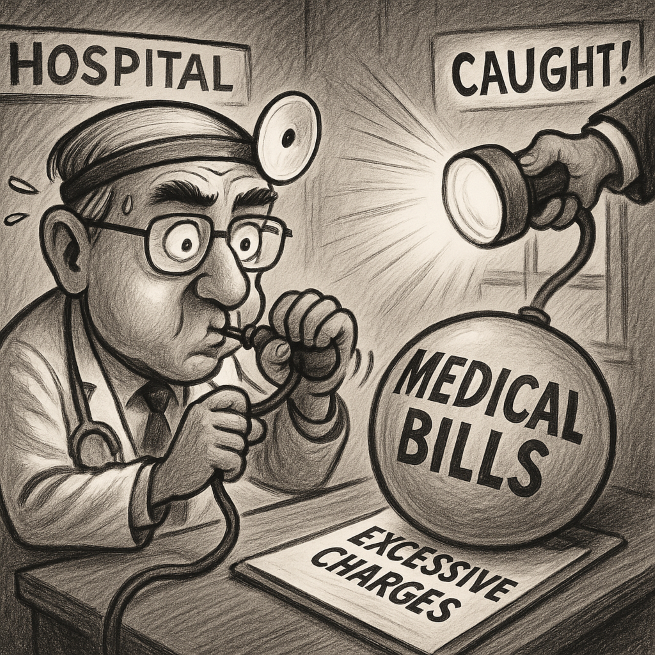
New model identifies cost anomalies across clinics and hospitals to improve oversight and protect public insurance funds. (Image supported by ChatGPT)
SEOUL, May 8 (Korea Bizwire) — As concerns mount over the long-term sustainability of South Korea’s national health insurance system, the government has introduced a new AI-powered model designed to more precisely detect medical institutions suspected of overcharging patients.
The Health Insurance Review and Assessment Service (HIRA) announced Thursday that it has developed an advanced analytics system that uses artificial intelligence to identify so-called “outlier institutions” based on a granular analysis of billing practices. The tool is expected to outperform previous methods by incorporating both institutional characteristics and itemized billing patterns.
Previously, hospitals and clinics were evaluated against national averages within broad categories such as hospital size or type — an approach that failed to account for differences in patient mix, medical specialties, or regional factors. This often led to inaccurate comparisons and overlooked outliers that billed disproportionately for specific services.
The new model categorizes clinics by 26 medical specialties — including internal medicine, surgery, and pediatrics — and divides hospitals into two groups based on whether they have more or fewer than 100 beds.
Within these peer groups, the system applies a flexible statistical threshold to flag institutions whose costs significantly exceed the norm. Rather than relying on a fixed benchmark (previously an ECI, or Episodes-Costliness Index, of 1.5), the model uses quartile-based thresholds to improve sensitivity and fairness.

AI Tool Exposes Overbilling Patterns in Korean Healthcare System. The exterior view of the Health Insurance Review and Assessment Service (HIRA) headquarters (Image provided by HIRA)
Crucially, the system goes beyond total charges and drills down into costs for specific medical services — such as consultations, prescriptions, injections, lab tests, and imaging — allowing HIRA to catch institutions that may not appear excessive overall but exhibit abnormal billing in certain areas.
In a pilot analysis using data from the fourth quarter of 2024, the model flagged a larger number of suspect institutions than the traditional method: 427 clinics and 24 hospitals, up from 322 and 2, respectively.
Among them were many facilities previously not flagged under old criteria but found to be charging abnormally high fees for lab tests — often through bundled “test sets” — suggesting potential abuse or inefficiency in medical practice.
The AI system also demonstrated better agility in tracking emerging billing patterns. It increased the detection of newly flagged institutions by 14.6 percentage points for clinics and 17.5 percentage points for hospitals, while reducing repeated quarterly detections, indicating a more dynamic monitoring capability.
HIRA officials said the new model will help distinguish legitimate cost differences from excessive or inefficient spending, ultimately strengthening the financial sustainability of the National Health Insurance system. The agency also plans to supplement the model’s findings with expert review and in-depth audits to account for statistical limitations.
“The goal is not to penalize fair practice,” a HIRA spokesperson said, “but to ensure that public healthcare funds are used effectively and responsibly.”
M. H. Lee (mhlee@koreabizwire.com)