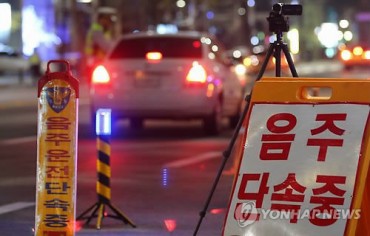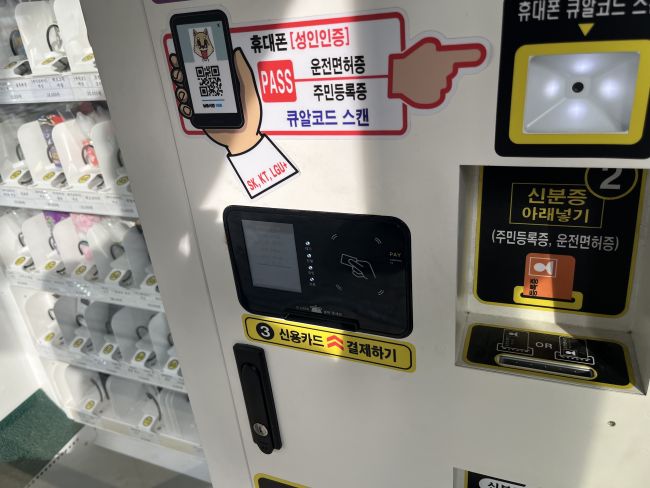
Liquid E-cigarette Vending Machine. (Image courtesy of Yonhap)
SEOUL, May 13 (Korea Bizwire) — Unregulated electronic cigarette vending machines selling synthetic nicotine products are proliferating near schools in South Korea, sparking public concern over youth access and health risks, amid mounting calls for legislative reform.
A recent investigation revealed unmanned vape shops operating near elementary, middle, and high schools in central Seoul, often featuring neon signs and openly displaying liquid-based e-cigarette vending machines at storefronts.
Despite existing laws that prohibit tobacco vending machines within 200 meters of schools, these shops are exploiting a legal loophole: synthetic nicotine is not classified as “tobacco” under South Korea’s Tobacco Business Act.
These liquid-based e-cigarettes, which use chemically synthesized nicotine rather than natural tobacco leaves, currently fall outside the scope of tobacco-related taxes, health surcharges, and online sales restrictions.
This has allowed vendors to operate with little oversight, often using lax ID verification systems that can be bypassed with photocopies or borrowed identification.
Parents and health advocates warn that the affordability and discreet design of these e-cigarettes—often resembling smartwatches and featuring fruity flavors like strawberry or grape—are accelerating their use among teenagers.
Liquid-based e-cigarettes are now estimated to account for 10–20% of the domestic tobacco market, with youth smoking rates potentially far higher than government statistics suggest.
Health authorities have flagged the danger. The Korea Disease Control and Prevention Agency (KDCA) noted that liquid e-cigarettes often serve as a gateway to combustible tobacco use.
Meanwhile, a proposed law to classify synthetic nicotine as a regulated substance under the Tobacco Business Act has stalled in the National Assembly for years, despite repeated calls from government ministries to close the regulatory gap.
In February 2025, Vice Finance Minister Kim Yun-sang reiterated the need for unified regulation of all nicotine products—synthetic or natural—and supported immediate taxation of synthetic nicotine. The Ministry of Health also confirmed through studies that synthetic nicotine poses comparable health risks to its natural counterpart.
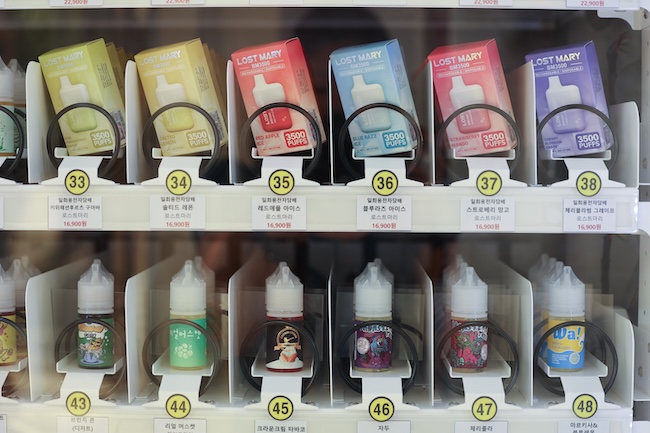
Liquid e-cigarettes (Image courtesy of Yonhap)
Still, proposed legislation failed to advance past committee stage amid political pushback from lawmakers citing the economic concerns of small vape retailers.
As a result, an estimated ₩1.1 trillion ($800 million) in tax revenue was lost in 2024 due to the unregulated sale of synthetic nicotine products, according to lawmaker Song Eon-seok.
By contrast, other countries have moved decisively. The United States began regulating synthetic nicotine under the FDA in 2022, with 33 states now imposing excise taxes on e-cigarettes. The U.K. plans to introduce a vape tax in October 2026, and Australia has restricted all e-cigarette sales to pharmacies regardless of nicotine content since July 2024.
A legislative research body urged the Korean government to follow suit, warning that continued inaction could worsen nicotine addiction among youth and undermine public health efforts.
“There is an urgent need to amend the law to allow for taxation and regulation of synthetic nicotine,” the National Assembly Research Service stated.
M. H. Lee (mhlee@koreabizwire.com)