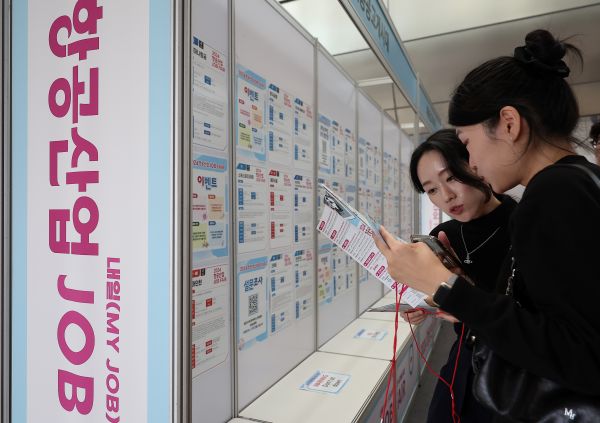
Aerospace Industry Job Fair. (Image courtesy fo Yonahp)
SEOUL, May 23, 2025 (Korea Bizwire) – South Korea’s aviation sector is accelerating hiring efforts across key roles—including pilots, flight attendants, and maintenance personnel—as airlines prepare for a post-pandemic surge in passenger demand, expand their fleets, and brace for structural industry realignment.
Korean Air, the country’s largest carrier, began accepting applications this week for summer internship programs in aircraft operations and technical control. Interns who complete the program between July and August will be eligible for full-time positions in early 2026.
The airline also recently recruited technical trainees for aircraft and engine maintenance, offering internship opportunities with a pathway to permanent employment after two years.
These recruitment efforts are part of Korean Air’s broader plan to support the introduction of new aircraft models such as the Boeing 787-9 and 787-10 and Airbus A350-900, while preparing for its merger with Asiana Airlines, which is expected to form a unified flag carrier.
Asiana Airlines is also actively recruiting. Earlier this year, the company hired new pilots and maintenance staff, and is currently in the process of hiring over 100 new flight attendants, scheduled to begin work in August. The airline is reviving recruitment momentum that had slowed prior to its acquisition by Korean Air.
Low-cost carriers (LCCs) are equally aggressive in their hiring push. T’way Air, expanding into Europe and North America, has hired 117 staff so far this year—including 20 pilots, cabin crew, and flight operations personnel, along with 54 maintenance engineers. More hiring is expected in the second half as the airline adds new A330-200 aircraft to its fleet.
Jeju Air, recovering from a high-profile runway accident in late 2024, is focusing heavily on safety personnel. The airline hired around 40 maintenance staff in the first half of 2025 and plans to bring in another 30 by year’s end, alongside ongoing recruitment for maintenance trainers.
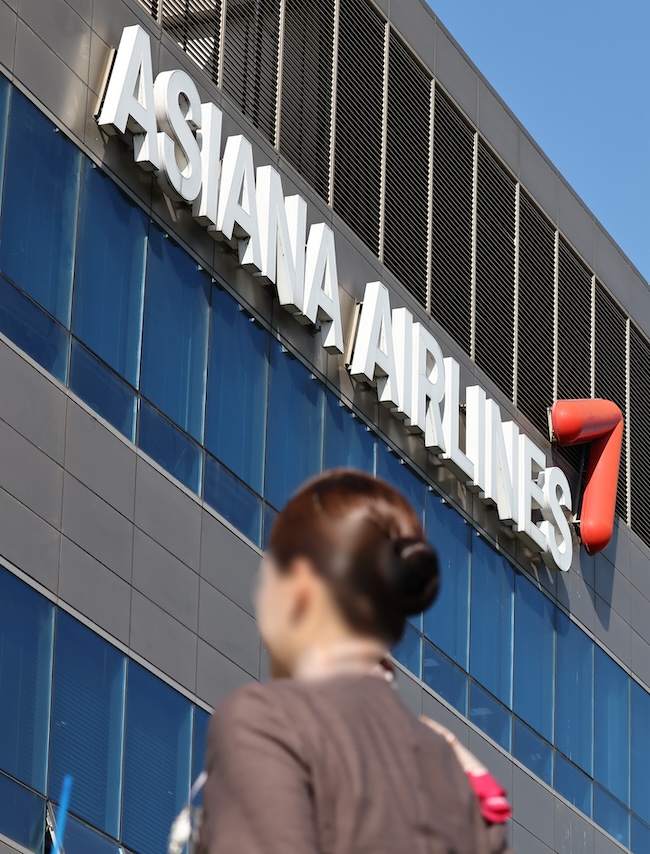
A flight attendant enters the headquarters of Asiana Airlines Inc. in Seoul on Nov. 2, 2023. (Image courtesy of Yonhap)
It also plans to hire around 60 cabin crew and 100 pilots to support the deployment of its next-generation Boeing 737-8 aircraft.
Eastar Jet and Air Premia are also ramping up their headcount. Eastar has reopened recruitment for flight attendants and first officers in May, anticipating the delivery of five new aircraft and new route expansions later this year. Air Premia, which hired new copilots and maintenance personnel late last year, added over 50 cabin crew members this month.
Parata Air, formerly Fly Gangwon, is also preparing for a relaunch in the second half of 2025. It recruited over 100 new staff earlier this year and has since expanded hiring for operations and maintenance departments.
As of March 2025, the combined number of commercial aviation personnel in South Korea—including pilots, flight attendants, maintenance engineers, and operations staff—stood at approximately 29,600, up 5.4% from pre-pandemic levels in 2019.
An industry official noted, “As global travel demand rebounds and domestic carriers introduce new routes and aircraft, recruiting top talent is critical not only for service quality and safety but also to secure competitiveness in a rapidly consolidating airline industry.”
M. H. Lee (mhlee@koreabizwire.com)