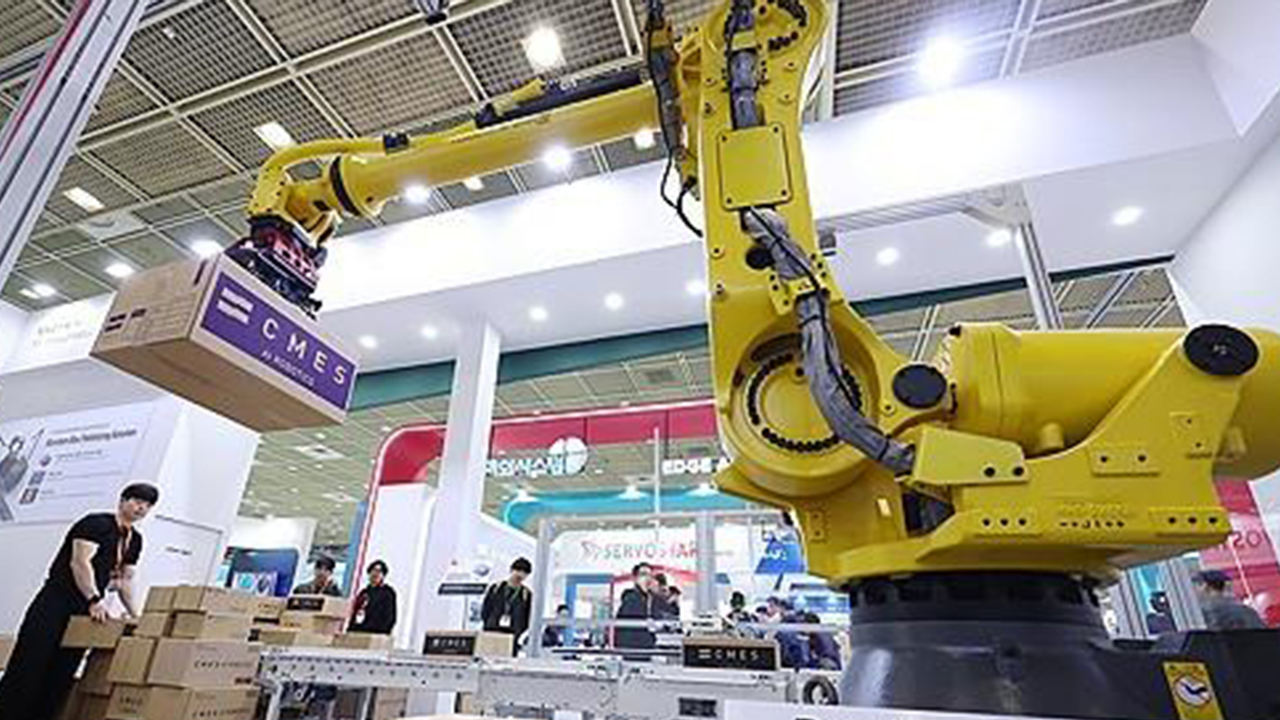
Demonstration of an AI system applied to item sorting and delivery (Image courtesy of Yonhap)
SEOUL, June 9 (Korea Bizwire) — Four in ten South Korean companies have already implemented artificial intelligence technologies in their operations, marking a rapid acceleration of AI adoption across industries, according to a new government-backed report released on June 8.
The report, commissioned by the Ministry of Trade, Industry and Energy and conducted by E-Consumer, surveyed 685 businesses nationwide and found that 37.1% have integrated AI into their workflows. Larger corporations led the way with a 65.1% adoption rate, while smaller firms (35.6%) slightly outpaced mid-sized enterprises (31.2%).
Firms currently using AI reported tangible benefits such as increased productivity (33.6%), reduced operating costs (26.0%), and improved speed and accuracy in decision-making (22.1%). Large corporations and small businesses highlighted productivity gains as the primary advantage, while mid-sized companies emphasized decision-making improvements.
The most common use cases for AI included research and development, process optimization, customer care, and market forecasting. Interestingly, while large enterprises primarily applied AI to customer service, small and mid-sized firms focused more on R&D applications.
Despite the positive impacts, companies cited several challenges in adopting AI. Chief among them was a shortage of skilled technical talent, followed by insufficient internal data, high upfront investment costs, and underdeveloped technological infrastructure.
When asked what kind of government support would be most beneficial, nearly half (49.8%) of AI adopters called for R&D subsidies, while 15.1% favored infrastructure-building assistance. Companies also sought support in areas such as workforce development and enhanced data security practices.
Among firms that have not yet adopted AI, only 39.9% expressed plans to do so, citing initial investment costs and lack of skilled personnel as the main barriers. For these companies, proposed government support measures mirrored those of existing adopters, including funding for R&D (31.5%), infrastructure development (24.6%), and training programs (18.0%).
The report concluded that AI integration is no longer optional but essential for maintaining competitive advantage, urging the government to implement tailored support strategies based on company size, sector, and regional characteristics.
“AI is at the heart of corporate competitiveness,” the report stated. “To accelerate adoption and maximize utility, government support must go beyond funding and include comprehensive aid covering technology, talent, security, and ethics.”
Ashley Song (ashley@koreabizwire.com)