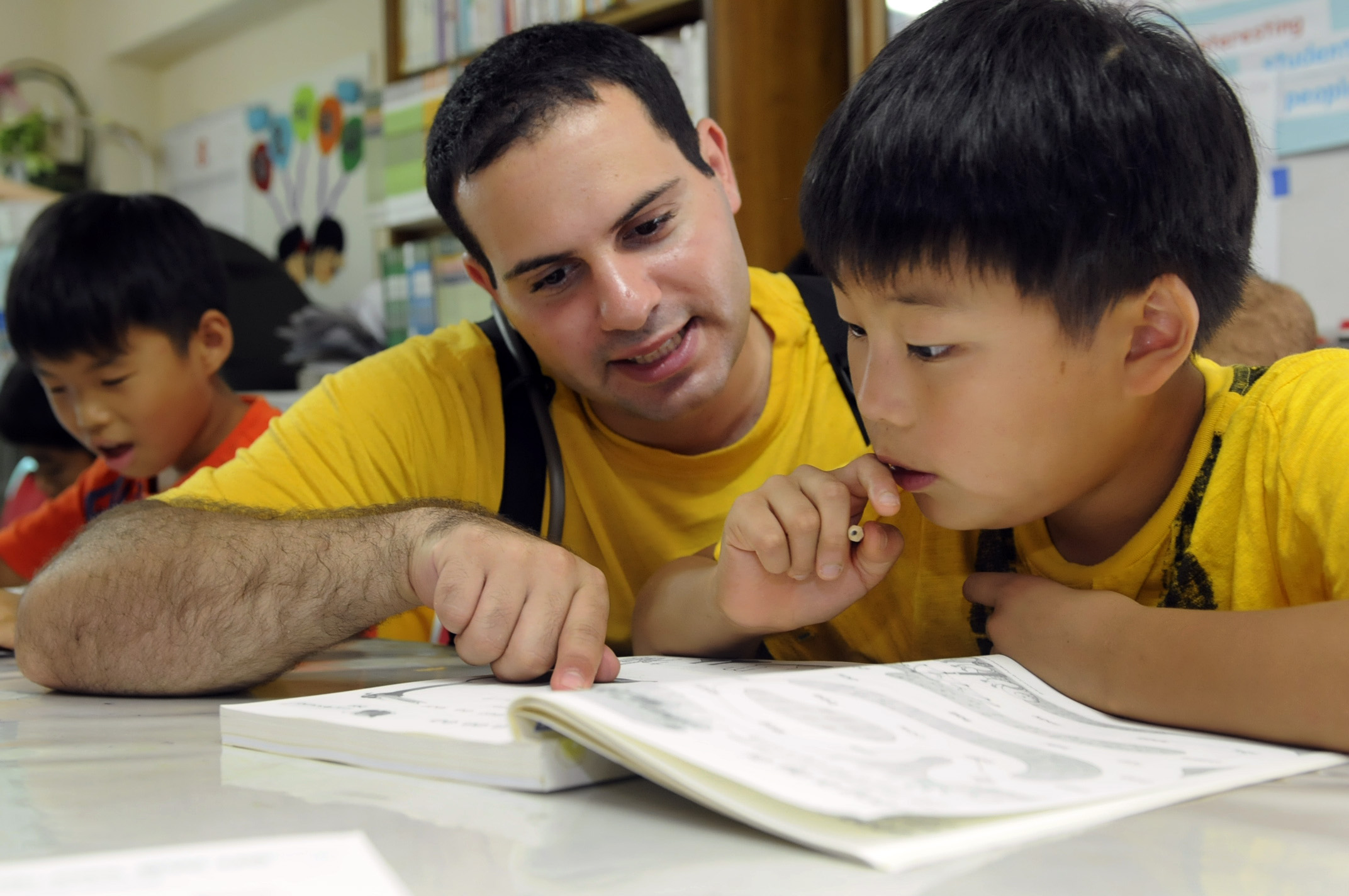
A recent survey has revealed that South Korean mothers send their kids to English classes before the children turn five years old on average. (Image Credit: Wikimedia)
SEOUL, June 11 (Korea Bizwire) – As the craze for early English education intensifies in South Korea, tuition at so-called “English kindergartens” — private institutions offering immersive language instruction for preschoolers — has surged significantly over the past year, according to a new report.
Data compiled by lawmaker Kang Kyung-sook of the Innovation Party and education watchdog group “World Without Shadow Education” revealed that average monthly tuition for English kindergartens in 2024 reached approximately 1.36 million won (US$990) in Seoul and 1.23 million won in Gyeonggi Province — year-on-year increases of 3.5% and 10.1%, respectively.
The findings were based on a comprehensive survey of English kindergarten operations in Seoul and five Gyeonggi cities (Goyang, Anyang, Seongnam, Yongin, and Hwaseong), conducted between May 7 and 30, using registration and disclosure data from education authorities and public childcare platforms.
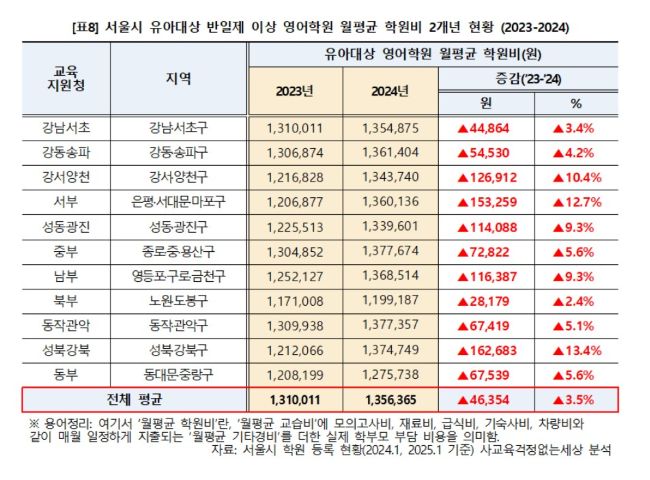
Two-Year Trend of Average Monthly Tuition Fees at English Kindergartens in Seoul. (Image courtesy of World Without Worries About Private Education)
Tuition figures include instructional fees, material costs, meals, transportation, and boarding charges, but exclude additional after-school programs, meaning the actual cost burden on parents is likely even higher. Based on current rates, annual tuition per child can exceed 15 million won (over US$11,000).
Notably, tuition hikes were steepest in western Seoul and northern districts like Gangseo, Yangcheon, and Seongbuk, where increases surpassed 10%. In Gyeonggi Province, Yongin saw the sharpest spike, with a 13.7% increase from the previous year.
While the number of English kindergartens in Seoul dropped from 333 to 299 in 2024, and the number of classes declined as well, the trend masks regional disparities. In affluent districts like Gangnam and Seocho, the number of institutions fell, but class openings jumped — suggesting consolidation among larger, more competitive operators.
Conversely, Gyeonggi Province experienced an overall expansion. Although the number of English kindergartens fell slightly to 119, the total number of classes jumped from 275 to 376. Anyang stood out with an explosive increase in class offerings — from 22 in 2023 to 116 in 2024.
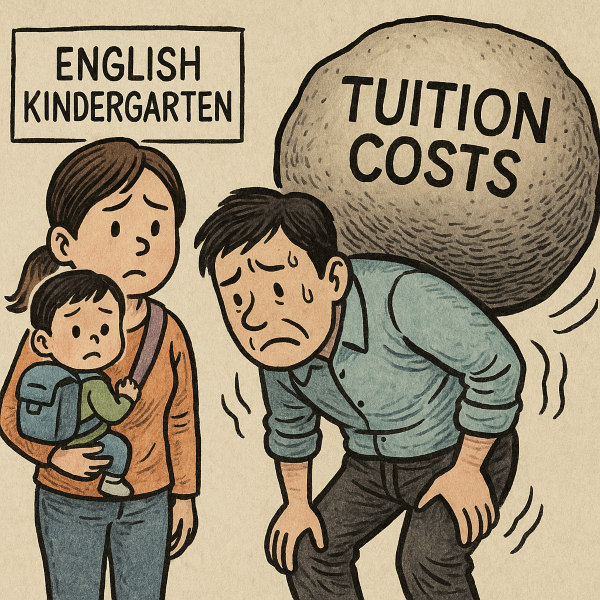
Parents Face Soaring Costs as English Preschool Fees Surge in Seoul and Gyeonggi (Image supported by ChatGPT)
“The market is shifting toward a model where large, well-resourced academies dominate, while smaller institutions are gradually pushed out,” said the education advocacy group in a statement.
The report also underscored the intensity of instruction: average daily class time at English kindergartens was 5 hours and 24 minutes in Seoul and 5 hours and 8 minutes in Gyeonggi — nearly two hours longer than the average school day for first and second graders in public elementary schools, and even exceeding that of middle school first-year students.
As costs climb and classroom hours lengthen, calls for tighter oversight and policy intervention are growing amid fears that South Korea’s booming private preschool English education sector may be widening social inequality and placing unsustainable financial pressure on families.
M. H. Lee (mhlee@koreabizwire.com)