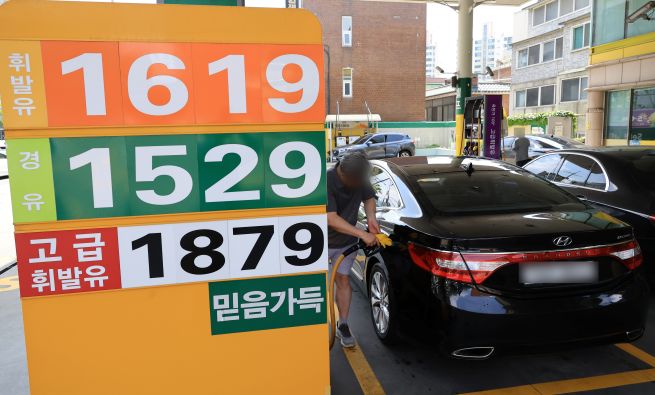
As news broke on June 13 that Israel had carried out an airstrike on Iran, international oil prices surged by 10 percent. The impact of this price volatility is expected to be reflected in domestic fuel prices with a time lag. (Yonhap)
SEOUL, June 15 (Korea Bizwire) — A sharp spike in global oil prices, triggered by Israel’s recent airstrike on Iranian nuclear facilities, is injecting fresh uncertainty into South Korea’s refining sector just as it showed signs of recovery.
Industry analysts say the attack—amid already fragile geopolitical conditions—has heightened concerns over global supply disruptions and intensified volatility in the energy markets. On June 13, crude prices surged as much as 13% intraday, renewing fears of a destabilized Middle East supply chain. Iran remains a major exporter to Asia, especially China and India.
Until the escalation, South Korean refiners had begun to see a recovery in refining margins, a key profitability metric calculated by subtracting crude oil costs and operating expenses from petroleum product prices.
According to industry data, composite refining margins rose from $2.40 per barrel in early April to $7.20 in early June, surpassing the typical breakeven range of $4 to $5.
The rebound was attributed to reduced refining capacity worldwide, including shutdowns of 547,000 barrels per day in the U.S. and 400,000 barrels in Europe, along with a temporary outage of 1.5 million barrels per day in the Iberian Peninsula due to a late-April power failure. Seasonal demand from the northern hemisphere’s summer driving season was also expected to bolster profits.
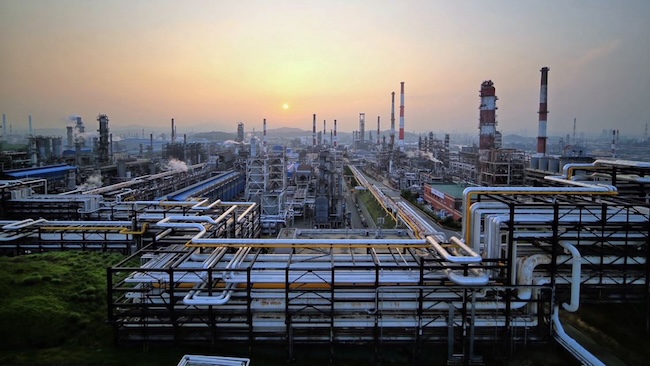
This file photo provided by SK Innovation shows its refining plant in Ulsan, 300 kilometers southeast of Seoul. (Image courtesy of Yonhap)
However, the geopolitical shock has disrupted the outlook. While rising oil prices can temporarily boost earnings through inventory gains and tighter product supply, refiners also face mounting risks: higher crude procurement costs, dampened consumer demand due to inflationary pressure, and more difficulty forecasting earnings.
“With the economy in a slowing phase, a spike in oil prices could significantly hurt demand,” said an industry insider. “And if prices continue to fluctuate wildly, it undermines visibility for future profits.”
Historical precedent underscores the double-edged nature of such market dynamics. In early 2022, during the initial phase of the Ukraine war, Korean refiners enjoyed record profits as Brent crude surpassed $100 per barrel. But current economic conditions are less favorable.
Recent earnings forecasts reflect a grim near-term outlook. According to consensus data from local brokerages compiled by Yonhap Infomax, S-OIL, which posted a ₩21.5 billion loss in Q1 2025, is expected to widen its loss to ₩75.5 billion in Q2.
SK Innovation is forecast to report a ₩154 billion loss, while HD Hyundai Oilbank and GS Caltex are also projected to see sharp declines in operating profit.
With additional external risks looming—from stalled U.S.–Iran nuclear talks to ongoing Ukraine ceasefire negotiations and U.S.–China trade tensions—the refining sector faces a storm of uncertainty despite recent margin gains.
As one analyst put it, “The refining industry has entered a high-risk, high-variability zone where even positive indicators like margin growth come with significant caveats.”
Ashley Song (ashley@koreabizwire.com)