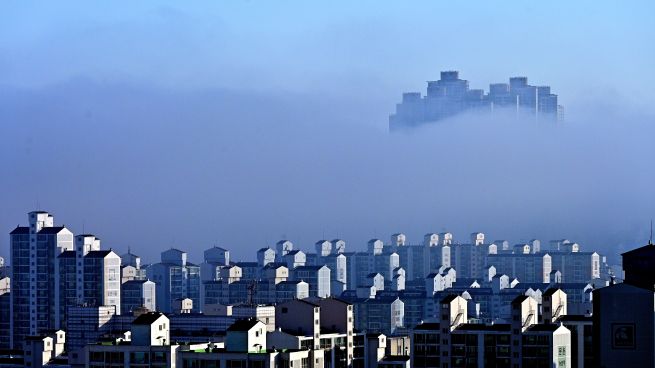
As the morning mist lifts from the city, the first rays of sunlight begin to shine through.
But when will that morning light reach the deeply divided housing markets across the regions? (Yonhap)
SEOUL, June 19 (Korea Bizwire) — The Bank of Korea has warned that continued efforts to stimulate construction investment through non-capital region housing projects may be exacerbating the nation’s widening housing market divide, rather than resolving it.
In a report released Wednesday, the central bank argued that building new homes in low-demand regions outside the Seoul metropolitan area is fueling an unsustainable cycle of oversupply and unsold inventory, deepening structural imbalances.
“Regional disparities in the housing market are manifesting in differentiated living costs, prolonged stagnation in construction activity outside the capital, and increased macroeconomic risks,” the report stated.
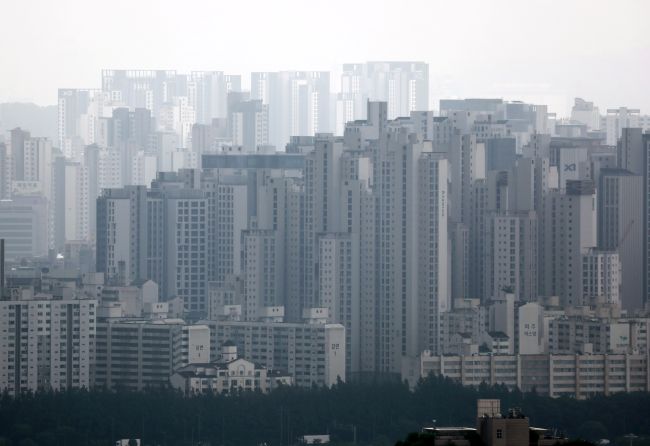
Apartment buildings in Seou(Image courtesy of Yonhap)
While South Korea’s overall post-pandemic housing price growth has remained modest compared to other advanced economies, the capital city has sharply outpaced the rest of the country.
From December 2013 to May 2025, the gap in cumulative home price increases between Seoul and the national average reached 69.4 percentage points—surpassing China (49.8), Japan (28.1), and Canada (24.5).
The report attributes this polarization to a confluence of factors: economic centralization, policy-driven housing booms, and demographic shifts. The Seoul metropolitan area now accounts for 53% of the nation’s gross regional domestic product, and employment and dual-income household rates continue to widen in its favor.
A growing influx of young people into Seoul, paired with continued outmigration from regional areas, has further skewed housing demand. Yet government policies have often focused on broad-based supply expansions, regardless of local demand dynamics. This has led to persistent oversupply and downward price pressures in many non-capital areas.
The result is a stark divergence in perceived housing costs. As of March 2025, average monthly housing costs for homeowners in Seoul stood at 2.29 million won, compared to just 510,000 won in North Gyeongsang and 490,000 won in South Jeolla.
This rising housing burden in the capital is also constraining household spending capacity, while weakening construction activity in the provinces continues to drag on regional economies. Employment in the construction sector and forward indicators like order volumes have stabilized in Seoul since last year, but remain in decline elsewhere.
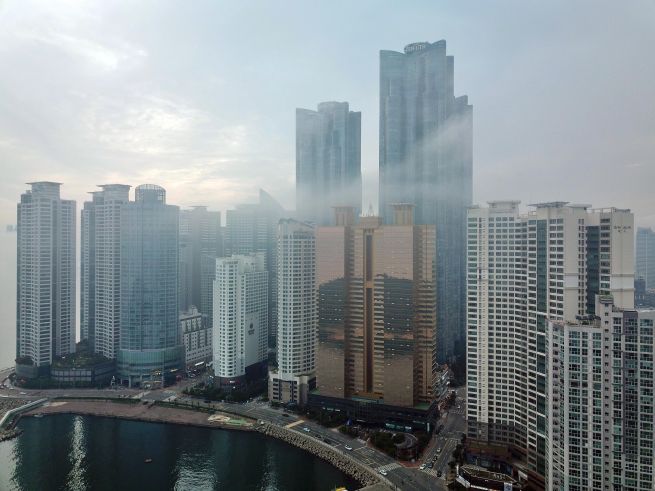
High-rise buildings located in Haeundae, Busan (Yonhap)
Financial risks are also diverging: Seoul faces increased household debt exposure due to rising home values, while non-capital regions face rising default risks linked to falling property values and stalled developments.
In response, the Bank of Korea urged policymakers to refrain from using regional housing construction as a primary stimulus tool, calling instead for more targeted macroprudential management.
More fundamentally, the central bank recommended investing in regional hubs to counterbalance Seoul’s economic dominance and alleviate excessive population concentration in the capital.
The housing divide poses a mounting policy challenge for President Lee Jae-myung’s administration, which has pledged to address regional inequality. Meanwhile, global financial uncertainty under the second Trump administration in the U.S. adds further complexity to South Korea’s economic landscape.
M. H. Lee (mhlee@koreabizwire.com)