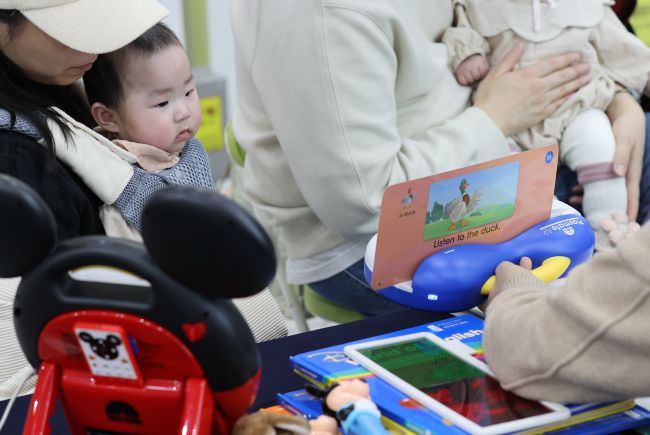
As of June 13, five out of 17 metropolitan municipalities in South Korea, including Seoul, Busan, and Sejong, have halted applications for preconception health management support due to the depletion of national (average 50%) or local government funds. (Image courtesy of Yonhap)
SEOUL, June 19 (Korea Bizwire) — A popular government program aimed at supporting reproductive health in South Korea is facing backlash after a wave of early closures due to budget constraints left many would-be applicants unable to access services.
As interest in preconception health rises sharply among younger adults, some local governments have already exhausted their annual funding—months ahead of schedule.
The Ministry of Health and Welfare confirmed Wednesday that as of June 13, five of the country’s 17 major local governments, including Seoul, Busan, and Sejong, have halted applications for the Preconception Health Support Program, citing depleted central or municipal funds.
Launched in 2024 and expanded in 2025 under the administration of President Lee Jae-myung, the initiative covers fertility-related diagnostic costs for men and women aged 20 to 49, regardless of marital status. Eligible women receive ovarian function tests and gynecological ultrasounds, while men can access detailed semen analyses. The maximum support is ₩130,000 for women and ₩50,000 for men.
Initially limited to married or soon-to-be-married couples, the program was broadened this year to include all individuals in the target age group. It also expanded coverage from a one-time benefit to three life-cycle-based uses. Government funding was increased from ₩6.25 billion in 2024 to ₩9 billion in 2025.
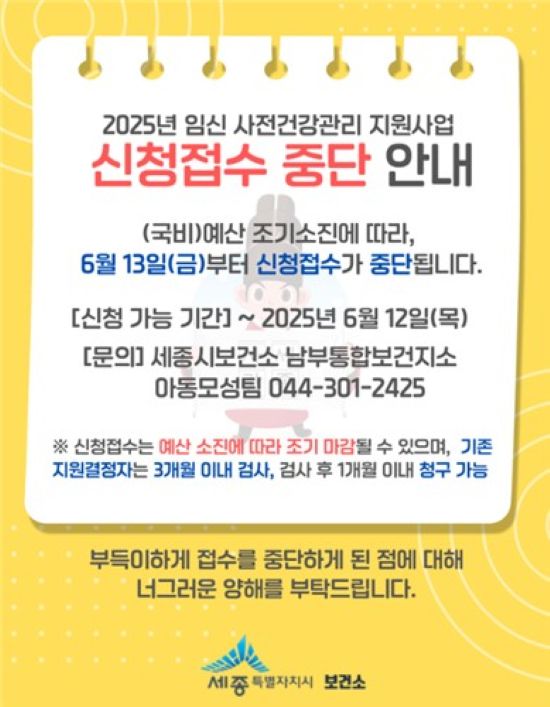
Sejong City Public Health Center Notice (Image courtesy of Yonahp)
However, that expansion has been met with overwhelming demand. More than 201,000 people had applied as of early June—far surpassing initial projections and straining allocated resources.
In Goyang, Gyeonggi Province, a 33-year-old woman surnamed A was told last month that her local clinic had already closed applications and would not reopen them until early 2026. Facing time-sensitive fertility plans, she was forced to pay out-of-pocket for her tests. “It’s a great program in theory,” she said, “but shutting it down before mid-year defeats its purpose. Not everyone plans a pregnancy in January.”
Online communities have been flooded with similar stories. “I booked a clinic visit thinking June would still be safe,” one commenter wrote. “But our region closed in April.”
Some cities, including Seoul, even resorted to using 2025 funds to pay for services already provided in late 2024 due to last year’s early budget exhaustion. While recipients praised the program’s goals and broader eligibility, many expressed frustration over inconsistent access between neighboring districts.
Experts say the surge in demand may have been predictable. Cho Young-tae, a professor of public health at Seoul National University, noted that the 1994 birth cohort—totaling around 720,000—marked a notable spike in population compared to earlier years.
“That group is now entering peak marriage and childbearing age,” he said. “It’s time for the government to recalibrate its support policies accordingly.”
The Health Ministry said it is working to address regional imbalances by encouraging cities and counties to reallocate funds internally and is seeking additional resources.
But a ministry official acknowledged challenges, noting that the program relies on a health promotion fund, not the general budget. “We are doing everything we can to secure more funding and plan to release additional allocations soon,” the official said.
The funding crunch comes amid mounting national concerns over demographic decline and fertility rates, a central issue for President Lee’s administration. The program’s popularity—and the strain it has placed on local services—underscores both the appetite for more reproductive support and the challenges of scaling policy to meet rising generational demand.
M. H. Lee (mhlee@koreabizwire.com)