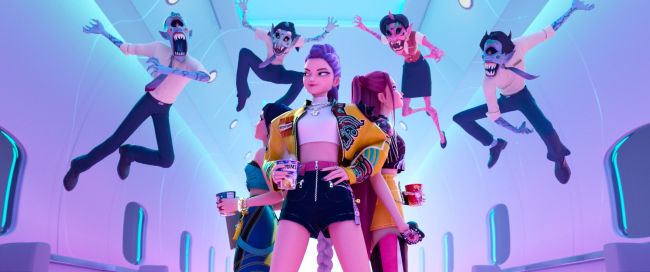
Netflix’s latest animated film, “K-Pop Demon Hunters,” blends the high-energy world of Korean pop music with supernatural thrills, as showcased in a standout midair battle scene. (Image courtesy of Netflix)
SEOUL, June 25 (Korea Bizwire) – In a rare fusion of K-pop glamor and supernatural adventure, K-Pop Demon Hunters, a new Netflix animated film, has taken the world by storm—climbing to the top of global streaming charts just days after its release.
The film follows Huntress, a K-pop girl group who moonlight as demon slayers protecting humanity through the power of song. As they prepare for the finale of their world tour, the group faces off against a villainous boy band backed by an underworld king named Gwima.
The narrative, which blends mythological motifs like dokkaebi (Korean goblins) and jeoseung-saja (grim reapers) with glitzy idol life, unfolds in dramatic fashion—from a chaotic in-flight battle to a stadium showdown.
Since debuting on June 20, the film has topped Netflix’s global movie rankings, hitting No. 1 in 26 countries including the U.S., U.K., Germany, France, and Japan, according to data tracker FlixPatrol. It ranked in the Top 10 in 93 countries.
Directed by Korean-American duo Maggie Kang and Chris Appelhans and produced by Sony Pictures Animation, the film has garnered critical acclaim, with a 94% critics score and 95% audience rating on Rotten Tomatoes.
 Though primarily in English, the movie features Korean dialogue and voice performances from top Korean actors including Lee Byung-hun as villain Gwima and Ahn Hyo-seop as the boy band leader Jun-woo.
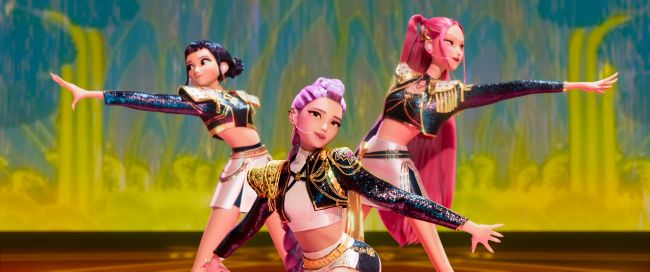
Audiences have praised the film’s distinct visual style, high-octane performances, and richly detailed worldbuilding. Each Huntress member—Lumi, Mira, and Joy—brings vivid personality to the screen, while their rivals, the sleek and perfectly synchronized Saja Boys, have captivated viewers with their visuals and choreography.
Complementing the action is a soundtrack produced by famed K-pop hitmaker Teddy. The film features up-tempo dance tracks like “How It’s Done” and “Golden” by Huntress, and “Soda Pop” by Saja Boys. TWICE appears on the opening track “Takedown,” while MeloMance’s ballad “Love, Maybe” is included in its original Korean form.
While rooted in the global appeal of K-pop, the film’s success also lies in its genre-blending originality. By mixing musical fantasy with occult elements, K-Pop Demon Hunters defies conventional storytelling, making it more than just another idol-themed movie.
South Korean audiences have praised the film’s nuanced depiction of everyday Korean culture—from eating gimbap and naengmyeon on a plane to treating a sore throat at a traditional herbal clinic. Meticulous cultural references include traditional motifs like the Ilwol Obongdo screen, dangsan trees, and cheering sticks, as well as Seoul landmarks like Namsan Tower.
Professor Yoon Sung-eun, a Korean film critic, remarked, “The film succeeds not only because of its K-pop hook, but because it subverts expectations. This isn’t a recycled idol-to-stardom tale—it’s an imaginative hybrid that showcases bold creative planning.”
Netflix representatives echoed that sentiment, calling the film a “well-crafted animation that fuses traditional Korean motifs with the trendiness of K-pop,” adding, “Its global popularity proves that great storytelling transcends language and borders.”
Lina Jang (linajang@koreabizwire.com)