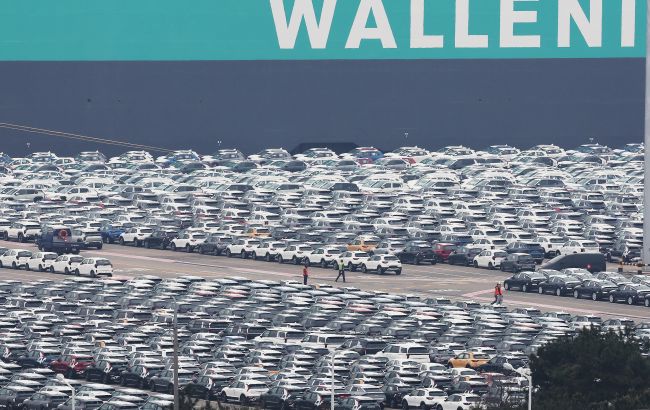
Rows of cars lined up for export. (Image courtesy of Yonhap)
SEOUL, June 27 (Korea Bizwire) – South Korea’s auto parts sector is bracing for intensified export headwinds as the United States signals a possible expansion of its 25% import tariffs on vehicle components, deepening concerns in an industry already grappling with high trade barriers.
On June 24, the U.S. Department of Commerce’s International Trade Administration announced a new process under Section 232 of the Trade Expansion Act that allows American manufacturers or associations to petition for additional parts to be included under the existing tariff scheme. The department must decide within 60 days of a request whether to impose duties on the targeted items.
The move has sparked alarm among South Korean suppliers, who are already reeling from a broad array of levies covering 332 product categories under the U.S. Harmonized Tariff Schedule. These include not only traditional internal combustion engine parts like engines and transmissions, but also electric vehicle components such as batteries and motors, as well as chassis, glass, and tires.
“The uncertainty is mounting,” said one industry official, pointing to the administrative and logistical challenges small and midsize firms face in tracking shifting tariff categories. According to the Korea Auto Industries Cooperative Association (KAICA), nearly 97% of South Korea’s auto parts companies are small and midsize enterprises, lacking the infrastructure or resources to relocate production to the U.S. or third countries.
The economic impact is already visible. In May, South Korea’s auto exports to the U.S. fell 32% year-over-year to $1.84 billion, while parts exports declined 8.3% to $430 million. Industry groups warn the situation could worsen if the tariff net expands further, threatening a sector that has become increasingly reliant on American demand. The U.S. now accounts for 36.5% of Korea’s total auto parts exports, up from 29.5% in 2020.
“The problem isn’t just direct costs from the tariffs,” said another industry representative. “It’s also the ripple effects — lower demand from automakers cutting production, pressure to reduce unit prices, and ultimately shrinking profit margins.”
The KAICA said the industry’s prior resilience was built on strong exports, especially as domestic demand faltered in recent years. But with exports now weakening, the buffer is eroding.
Last year, Korean auto parts exports to the U.S. hit a record $8.22 billion. Whether that figure can be sustained under the current trade climate is now in serious doubt.
M. H. Lee (mhlee@koreabizwire.com)