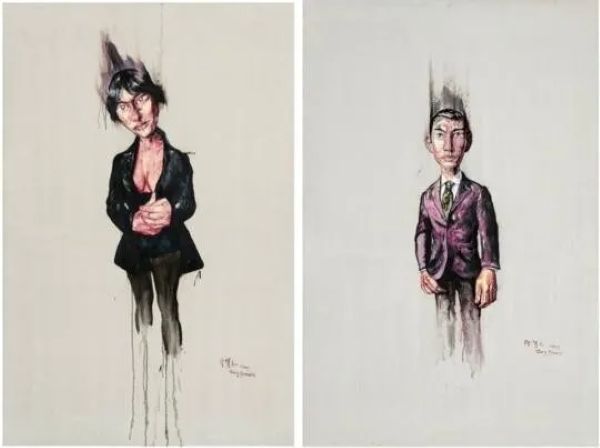
Two portrait paintings by Zeng Fanzhi, a star of contemporary Chinese art, were the first artworks accepted for tax payment in kind. (Photo provided by the Ministry of Culture, Sports and Tourism)
SEOUL, July 4 (Korea Bizwire) — South Korea’s Ministry of Culture, Sports and Tourism and the Korea Visual Artists Copyright Association convened a special policy seminar Thursday in central Seoul to discuss the future of the country’s nascent “art-for-tax” program, which allows inherited artworks to be used in lieu of cash for paying estate taxes.
The system, introduced in 2023, permits heirs to use cultural assets or artworks to cover inheritance tax liabilities when the tax exceeds 20 million won (approx. $14,500) and the value of non-financial assets surpasses that of financial holdings in the estate.
Held under the theme “Revitalizing Art-Based Tax Payments and Donations,” the seminar examined the program’s implementation, challenges, and strategies to expand participation.
Presentations included analysis by Kyung Hee University professor Choi Byung-sik on domestic and international examples of art inheritance and donation, and a proposal by Kookmin University’s Hwang Seung-heum for a centralized national artwork management framework. A panel of art and finance experts also joined to debate ways to improve the system.
“The art-for-tax system is a crucial mechanism for preserving the cultural and social value of artworks,” said Shin Eun-hyang, director of arts policy at the ministry. “We hope today’s discussion will help shape effective policy and encourage broader participation.”
The system saw its first real case in late 2023, when four works from a private collection were accepted in lieu of inheritance taxes. These included Sunrise by Lee Man-ik, Aggregation by Chun Kwang-young, and two portraits by Chinese contemporary art luminary Zeng Fanzhi — the latter marking the first time his works entered Korea’s National Museum of Modern and Contemporary Art collection via the program.
Zeng’s works had previously been listed for auction at K Auction with price estimates ranging from 1.15 billion to 1.5 billion won ($830,000 to $1.1 million), but were withdrawn before sale. The ministry noted that only four of ten submitted pieces were accepted based on criteria including artistic merit, preservation condition, and public utility.
Inspired by long-standing programs in Europe, Korea’s version of the art-for-tax policy gained momentum after two key events: the 2020 attempted sale of national heritage items by the Kansong Art and Culture Foundation, and the widely lauded 2021 donation of the “Lee Kun-hee Collection” by the late Samsung chairman’s family.
The government hopes this policy will not only ease the tax burden on heirs but also enrich national collections and prevent important artworks from being lost to private sales or overseas buyers.
M. H. Lee (mhlee@koreabizwire.com)