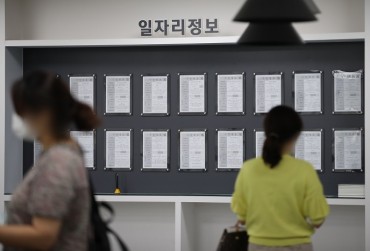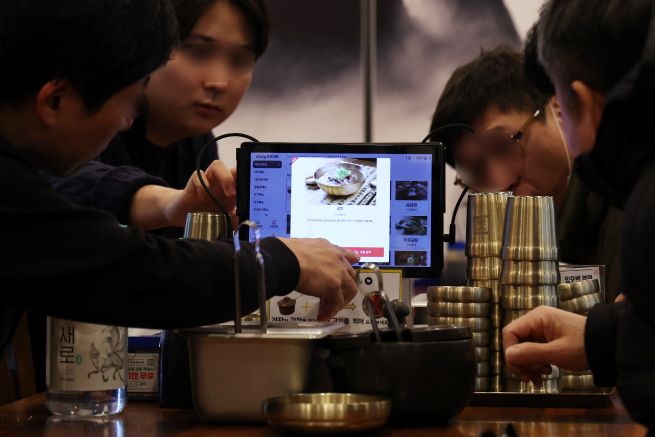
Amid the economic downturn and growing emphasis on labor cost reduction, demand for automated table-order systems in restaurants is on the rise. (Yonhap)
SEOUL, July 7 (Korea Bizwire) — Korean restaurants that adopt smart technologies such as delivery apps, kiosks, and table-order systems significantly outperform those that do not, according to a new study by the Korea Foodservice Industry Research Institute.
The survey found that restaurant owners using smart tools reported an average monthly revenue of ₩30.86 million and an operating profit of ₩11.34 million—figures that are 45.3% and 32.6% higher, respectively, than those of non-adopters.
Despite incurring 22.1% higher average monthly operating costs (excluding labor), smart-tech adopters still achieved greater profitability. The increased spending was attributed to rent, device rental fees, and platform commissions, but these costs were offset by gains in sales and efficiency.
The study surveyed 495 foodservice operators—242 using smart technologies and 253 not—and aimed to control for factors such as location, business size, and industry type. Researchers cautioned against broadly generalizing the findings but emphasized the strong correlation between tech adoption and business performance.
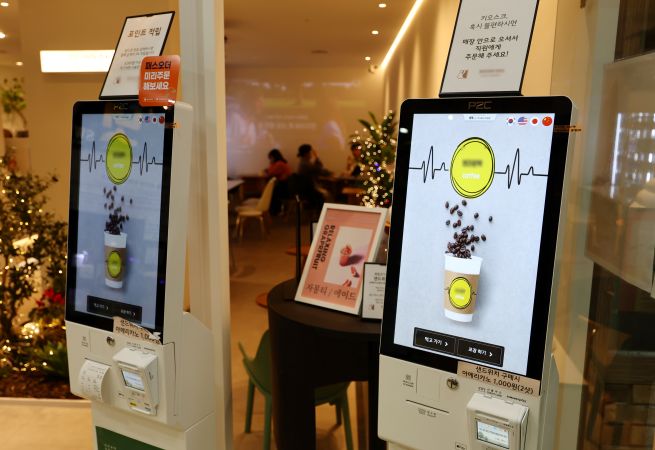
A kiosk installed at a café in Seoul. (Yonhap)
Smart technologies commonly used in Korea’s foodservice sector include delivery apps, kiosks, table-order systems, online reservation platforms, and service or cooking robots. These tools are not only improving operational efficiency but also shifting staff responsibilities toward higher-value tasks such as customer service, complaint resolution, and review management.
“Smart tech reduces labor intensity and enhances productivity, allowing employees to focus on added-value activities,” the institute stated. “Delivery apps drive external traffic, while kiosks and table-order systems reduce order errors and emotional strain on staff.”
The study also noted that restaurants using smart technology employ more staff—regardless of store size. Establishments larger than 30 pyeong (about 99 square meters) had an average of 4.83 employees with smart tools, compared to 3.88 for non-adopters. Even smaller restaurants saw a similar trend.
However, the report warned of the financial burden caused by overlapping service fees, particularly in delivery and table-order platforms. The institute called for clearer pricing structures and policy reforms to prevent excessive or redundant charges.
“Without fee transparency and structural adjustments, these platforms risk undercutting the very profitability they are meant to enhance,” the report concluded.
Lina Jang (linajang@koreabizwire.com)