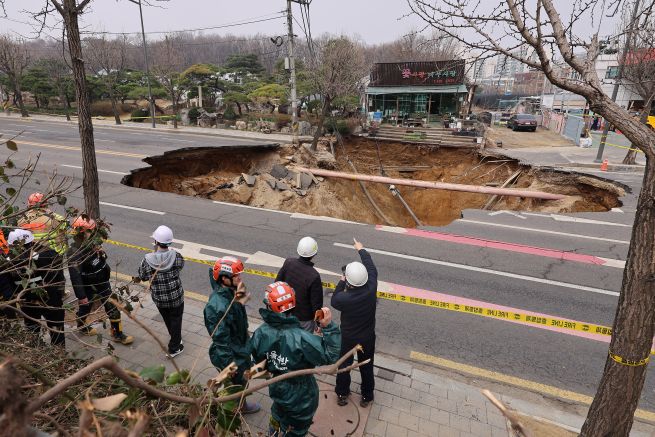
A view of the large sinkhole site on the road near Daemyeong Elementary School in Gangdong District on March 25 of this year. The previous day, on the afternoon of March 24, a massive sinkhole measuring approximately 20 meters in diameter and 18 meters deep opened at an intersection near Myeongil-dong’s Daemyeong Elementary School, causing a motorcyclist to fall in and go missing. (Photo provided by Yonhap)
SEOUL, July 14 (Korea Bizwire) — A total of 72 sinkholes were reported across Seoul during the first half of 2025, underscoring growing concerns about the city’s aging underground infrastructure and prompting a major government response.
According to data released Sunday by Seoul’s disaster and safety portal, Seoul Safer, sinkholes occurred at a rate of roughly one every 2–3 days between January 1 and June 30. Among the incidents, five were reported in the eastern district of Gangdong — including a massive sinkhole in Myeongil-dong that measured approximately 20 meters in both diameter and depth.
The highest number of sinkholes were concentrated in the city’s affluent southeastern districts of Gangnam, Seocho, and Songpa, which together accounted for 36 percent of total incidents. Gangnam alone reported 13 cases, followed by Songpa with 10 and Seocho with 3.
Experts attribute the high frequency to extensive underground excavation tied to skyscraper development, subway construction, and urban redevelopment — all compounded by the area’s proximity to the Han River and relatively weak subsoil.
May proved particularly alarming, with 44 sinkholes reported in a single month — coinciding with sudden torrential rains that led to major road and river closures. Other months saw more modest counts: 3 in January, 4 in March, 12 in April, and 9 in June. February saw no reported incidents.
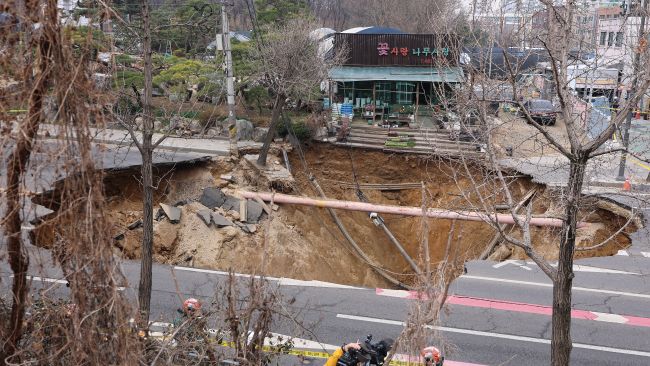
Aging sewer lines have been cited as a major cause of ground subsidence. Water leaking through cracks can erode soil beneath roads, leading to sinkholes. (Image courtesy of Yonhap)
The most common cause of the sinkholes was damage to sewer lines, responsible for 18 cases. Additional culprits included deteriorated manholes (11 cases), damaged storm drains (9), and water pipe leaks (3).
Notably, over 55 percent of Seoul’s 10,866-kilometer sewer network is more than 30 years old — a statistic city officials say raises the likelihood of recurring ground collapses.
To address the issue, the Seoul Metropolitan Government has announced a long-term plan to replace 200 kilometers of aging sewer lines annually through 2030. The project will be funded by 400 billion won (approximately $290 million) each year, combining special accounts, disaster management funds, national grants, and general municipal budgets.
Work is set to begin in September. “We are moving quickly to allocate funds and begin overhauling vulnerable sewer infrastructure,” a city official said.
M. H. Lee (mhlee@koreabizwire.com)