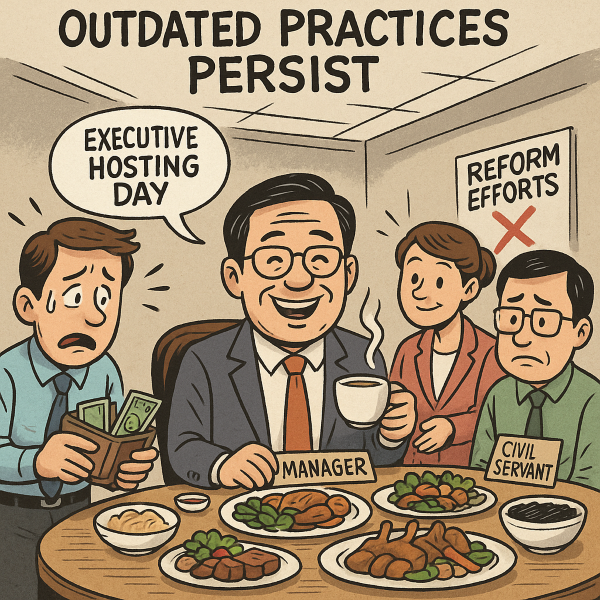
South Korea Cracks Down on Civil Service’s Meal-Treating Tradition (Image supported by ChatGPT)
SEOUL, July 16 (Korea Bizwire) — One in nine South Korean civil servants recently participated in the long-criticized custom of subordinates treating senior officials to meals, underscoring the persistence of outdated hierarchical practices within the public sector despite reform efforts.
A joint survey released Friday by the Ministry of the Interior and Safety and the Ministry of Personnel Management found that 11.1 percent of public servants had experienced what is colloquially known as “executive hosting day” within the past month.
The figure, while down from 18.1 percent in a similar survey last November, highlights the resilience of this tradition, where lower-ranking employees take turns paying for meals for their departmental heads using personal funds.
The practice, often viewed as symbolic of power imbalances and undue obligation, remains particularly entrenched at local government offices, although improvements were noted. The incidence at central government agencies dropped from 10.1 percent to 7.7 percent, and at local governments from 23.9 percent to 12.2 percent.
More than 113,000 civil servants responded to the internal poll, with nearly a third acknowledging that the practice has declined in recent months. Among those who had participated in such meals, 75.9 percent said the guest of honor held a department head (manager-level) position.
Asked why the custom persists, 35.8 percent cited an entrenched organizational culture that minimizes the issue, while 42.9 percent said raising awareness among senior officials is the most urgent need for change.
In response, the government has ramped up reform efforts. The Anti-Corruption and Civil Rights Commission is currently conducting a campaign to root out habitual abuses of power, and authorities have pledged follow-up measures, including the launch of an anonymous reporting system within the national human resources platform.
“Our goal is to completely eradicate these outdated practices,” said Park Yong-su, Vice Minister of Personnel Management. Kim Min-jae, Acting Minister of Interior and Safety, added that the government is committed to creating a “public sector environment where officials can focus on their work without undue pressure.”
Despite a drop in occurrence, the practice remains emblematic of deeper cultural norms that continue to challenge efforts toward bureaucratic modernization in South Korea.
M. H. Lee (mhlee@koreabizwire.com)