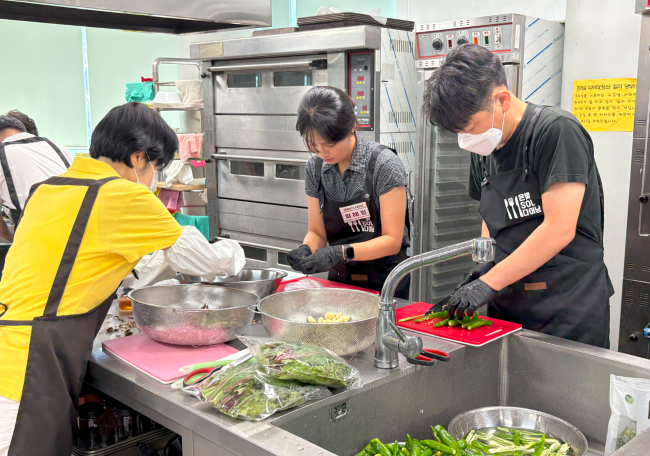
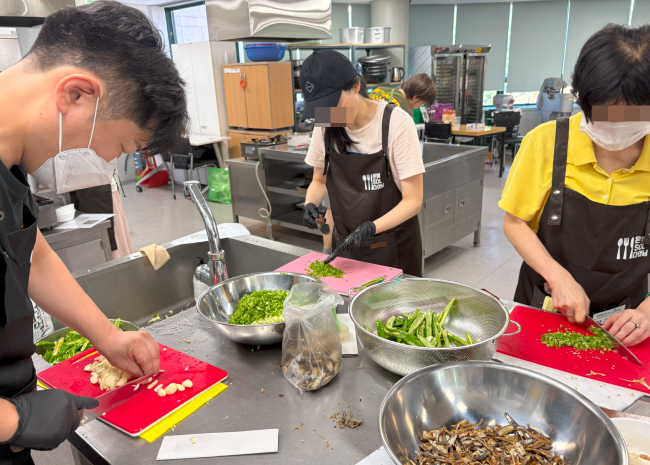
Silver SOL Dining program. (Image courtesy of Yonhap)
SEOUL, July 17 (Korea Bizwire) — On a quiet Friday afternoon in Eunpyeong District, a group of middle-aged Seoul residents gathered not just to cook—but to connect.
They were participants in Eunbit SOL Dining, a community cooking program that is part of Seoul’s broader Happy Table initiative aimed at reducing social isolation among one-person households aged 40 to 67.
Since its launch in 2022, Happy Table has offered a simple yet potent antidote to urban loneliness: bring strangers together over shared recipes and meals. On this day, participants prepared gochujang-mul, a spicy fermented anchovy sauce from Korea’s southeast region, traditionally enjoyed with rice or cabbage wraps.
While the dish itself was straightforward, the act of cooking—chopping anchovies, mixing ingredients, and exchanging tips—served as a vehicle for social warmth. “I’ve always eaten alone,” said Ms. Bae, a woman in her 50s. “It feels good to be out, talking to people, and cooking something with my own hands.”
Once the cooking concluded, participants sat in circles and shared a tuna bibimbap meal seasoned with the freshly made gochujang-mul. Conversations flowed naturally—from neighborhood small talk to swapping life stories. Leftover sauce was bottled and partially donated to a local children’s welfare center, strengthening the program’s communal ethos.
 The feedback was overwhelmingly positive. One participant remarked, “I live alone and often skip meals, but this gives me food for the next few days—and companionship.” Others expressed hope for more frequent participation, noting the current limit of two sessions per year.
Operated across all 25 Seoul districts, Happy Table is complemented by a parallel youth-focused program, Healthy Table, for one-person households aged 19 to 37. Both are free and can be accessed through Seoul’s official single-person household portal.
Seoul’s efforts come amid global concern over the health impact of loneliness. A recent WHO report warns that social isolation contributes to an estimated 100 deaths per hour worldwide.
In Korea, the issue has gained urgent relevance, especially for aging and single-resident populations. Programs like these—practical, low-cost, and rooted in shared daily rituals—offer a model of community care that others are beginning to replicate. The city’s new 365 Seoul Challenge for loneliness prevention has already drawn over 17,000 sign-ups in just a week.
“Sharing a meal means more than just eating—it’s about checking in, being seen, and being part of something,” said Professor Jang Eun-jin, a counseling psychologist. “These programs aren’t just about food. They’re about building micro-communities, where people can eventually lean on each other in times of need.”
Lina Jang (linajang@koreabizwire.com)