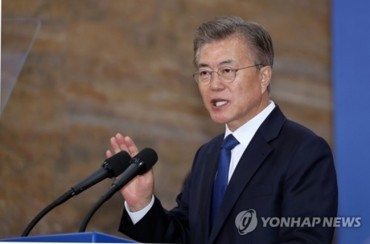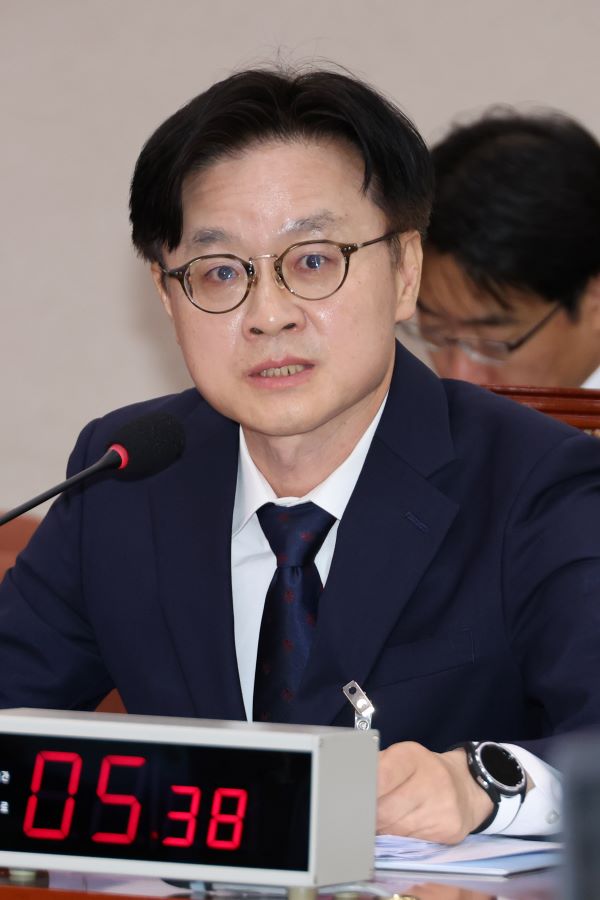
Industry Minister nominee Kim Jung-kwan speaks during a parliamentary confirmation hearing in Seoul on July 17, 2025. (Image courtesy of Yonhap)
SEOUL, July 17 (Korea Bizwire) — Industry Minister nominee Kim Jung-kwan on Thursday pledged to mobilize all available resources to boost exports and spur economic growth, while vowing to pursue “pragmatic” trade policies in response to the United States’ aggressive tariff scheme.
Kim made the commitment during his parliamentary confirmation hearing, after being nominated as the first industry minister under the Lee Jae Myung administration, at a time when South Korea is grappling with sluggish growth momentum and the Donald Trump government’s sweeping tariff measures.
“Free trade and international norms, which have driven our exports, are no longer functioning as they should, due to U.S. tariff measures and the spread of protectionism,” Kim said in his opening remarks. “I will mobilize all available resources to prop up exports and investment.”
“We will pursue pragmatic trade policies with a focus on maximizing national interests,” he added.
South Korea is working to reach a tariff agreement with the U.S., as Trump earlier said his government will impose 25 percent reciprocal tariffs on South Korean goods starting Aug. 1, unless a deal is reached beforehand.
The tariffs were initially supposed to take effect on July 8, following a 90-day suspension, but Trump extended the deadline to Aug. 1 to allow more time for negotiations.
Kim also stressed the need to expand the country’s global cooperation networks through trade agreements with various nations and its participation in international forums, such as the Asia-Pacific Economic Cooperation (APEC) summit.
“It is crucial to strengthen export infrastructure, which will help transform South Korea’s trade structure and usher in the era of US$1 trillion in exports,” the nominee said.
With regard to growing concerns over U.S. calls for South Korea to further open its agricultural and livestock markets, Kim said he fully understands the sensitivity of the issue and that the negotiation team is closely coordinating with relevant ministries.
There have been calls from the U.S. to address non-tariff barriers, including South Korea’s import ban on American beef from cattle over 30 months old. Concerns are also growing over potential U.S. demands regarding Seoul’s rice import quota.
South Korea has a baseline tariff of 513 percent on rice imports, but it imposes only a 5 percent tariff on a yearly quota of 132,304 tons of rice from the U.S. under an existing agreement.
Seoul officials have hinted at leveraging agricultural issues as bargaining chips in ongoing tariff negotiations with Washington. Trade Minister Yeo Han-koo told reporters earlier this week that it was time to make a “strategic” decision on agricultural issues and other key items under negotiation.
Priority will also be placed on the widespread adoption of artificial intelligence (AI) technologies and the reform of the research and development (R&D) framework to strengthen the foundation for future innovation, according to the nominee.
(Yonhap)