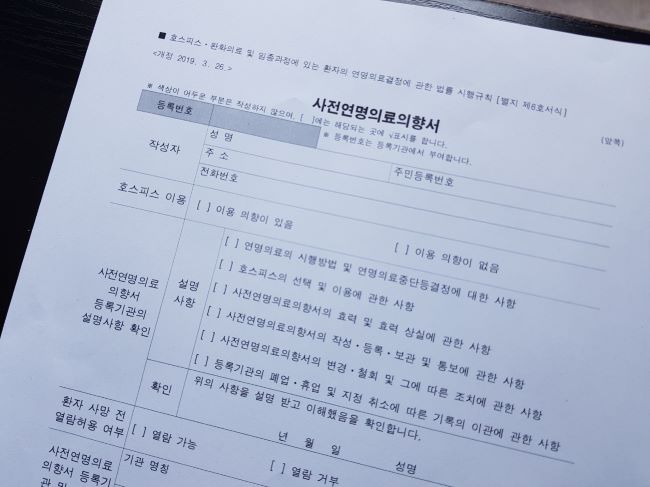
Advance Directives for Life-Sustaining Treatment. (Image courtesy of the Korea National Institute for Bioethics Policy, Life-Sustaining Treatment Management Center)
SEOUL, July 23 (Korea Bizwire) – Elderly individuals in South Korea who receive greater social support are significantly more likely to prepare for the end of life — including writing wills, completing advance directives, and planning funerals — according to new research released Tuesday by the Korean Public Health Association.
A team from Eulji University’s Department of Healthcare Management analyzed data from the 2023 National Survey of the Elderly, covering 9,955 respondents.
Researchers assigned each participant a social support score (ranging from 0 to 3) based on the number of people they could rely on for help, then compared those scores to indicators of “death preparedness.”
The study found that older adults with the highest level of social support (3 points) were 1.38 times more likely to have taken at least one step in planning for death — such as drafting an advance directive or will — compared to those with little or no support. Those with mid-level support (2 points) were 1.33 times more likely.
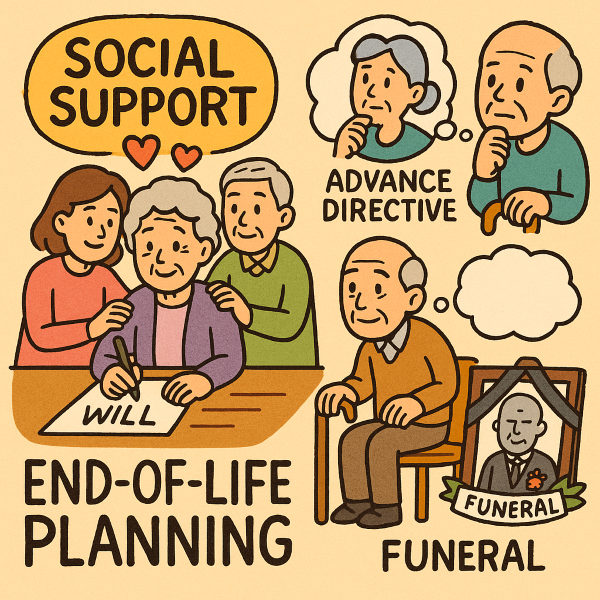
More Friends, More Peace: Study Finds Elderly Plan Better for Death with Social Support (Image supported by ChatGPT)
Education also played a role. Compared to those with a college education, elderly individuals with only elementary schooling were 28% less likely to be prepared for death.
Social participation, such as joining clubs or religious groups, similarly correlated with readiness — seniors not engaged in such activities were 37% less likely to have made end-of-life arrangements.
“Social support is not just emotional comfort; it serves as a key driver of practical death preparation,” the researchers said. They urged policymakers to develop tailored end-of-life education programs that take into account each individual’s support network, particularly for the socially isolated.
The findings highlight the growing need for community-based support systems to help aging populations make informed and dignified choices about their final stages of life.
Lina Jang (linajang@koreabizwire.com)